





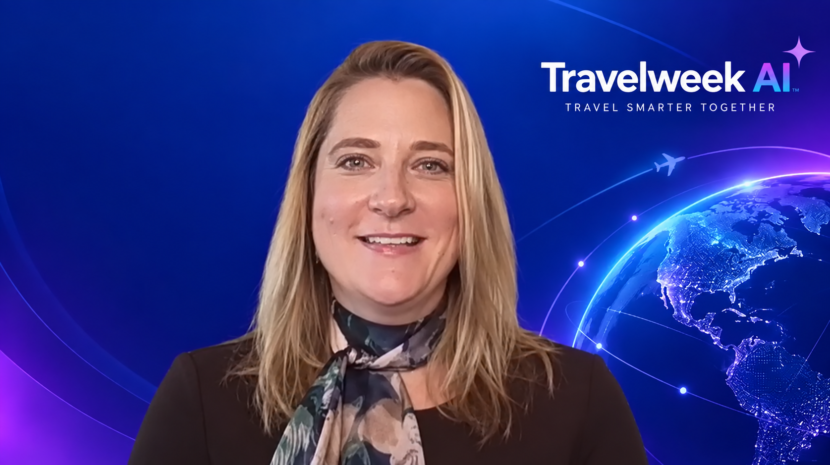
TORONTO — AI is moving well beyond the chatbot, and for travel advisors, that could mean fewer repetitive tasks, faster client work and more time to focus on selling travel.
That was the message at Travelweek’s “AI Unleashed with Claude” webinar on Sept. 23, hosted by Travelweek Publisher Devin Kinasz and featuring Shake Dewan, Chief AI Officer at AI Forward along with Juan Sebastian Sanchez Chica of ProColombia, who provided destination updates.
To watch the webinar, click here.
Kinasz opened the session by urging advisors to view AI not as a threat, but as a tool that is rapidly changing how work gets done.
“It’s not because AI is coming for your job. It’s because agents who learn this technology are going to be outperforming you,” she said.
Her advice to advisors was to move beyond simply asking AI questions and start looking at it as something closer to a digital colleague.
“I’m going to teach you how Claude can essentially be like another team member,” Kinasz said. “We’re going beyond just typing back and forth in a chat box.”
FROM CHATBOT TO WORKFLOW TOOL
Kinasz positioned Claude as particularly useful for larger, more complex assignments involving long documents, multiple files and ongoing projects.
While she described ChatGPT as a “Swiss Army knife” suited to research, brainstorming, comparisons and everyday tasks, Claude, she said, can act more like a “specialized scalpel” for deeper work.
For advisors, that could include organizing client projects, building itineraries, developing presentations, creating marketing campaigns, drafting reports and working across documents, emails and other business tools.
“AI is moving much beyond the simple chat box and prompting,” Kinasz said. “We’re now moving into a situation where [you’re] actually delegating work away from yourself.”
She demonstrated how Claude can retain instructions and reference files within individual projects, allowing an advisor to establish preferred writing styles, brand guidelines, client information and repeatable processes.
Once a workflow is established, it can also be saved and reused, potentially eliminating the need to rebuild the same process each time.
The possibilities extend into everyday administration. Kinasz outlined how AI could review recent client emails, flag unanswered questions, identify payment deadlines or supplier follow-ups and prepare draft responses for an advisor to approve.
Similarly, a supplier promotion could be transformed into an email campaign, social media posts and other marketing content without starting from scratch.
FOCUS ON THE BOTTLENECKS
Dewan brought the conversation back to one of the most valuable commodities in any advisor’s business: time.
“Your hours are your bottleneck,” he said. “Your time is what you have as your daily resource that you expend, and the leverage that you have in your time is the leverage that you have on your work in your day.”
Rather than trying to automate everything at once, Dewan encouraged advisors to identify the activities consuming the most time, whether that is research, quoting, proposals, marketing, follow-ups, administration or lead generation.
His recommended approach is to teach the AI a task, test it repeatedly until the output is right, then save that process for future use.
“You want to brief it, explain to it… build it and test it once,” he said. “And when it’s good enough, you want to essentially bottle it and make it reusable.”
That ability to reuse proven workflows, he said, is where much of the long-term efficiency comes from.
AI STILL NEEDS AN ADVISOR
Both Kinasz and Dewan stressed that AI output cannot simply be accepted without review.
Dewan noted that AI can make mistakes or “hallucinate,” particularly when dealing with factual information, pricing and availability. He encouraged advisors to provide clear context, rely on official sources and ask the technology to flag information that still needs verification.
“Claude is for drafting. You’re the ultimate and final decision maker,” Dewan said.
He also recommended reading AI-generated material carefully rather than allowing the technology to replace human judgment.
“It’s very easy to turn off your brain,” he said, noting that even small factual or tonal errors can slip through if advisors are not paying attention.
START SMALL, THEN BUILD
For advisors who feel overwhelmed by the speed of AI development, both Kinasz and Dewan offered similar advice: start experimenting.
Kinasz encouraged advisors to “play around” with the tools and gradually develop their skills over time, while Dewan said the best starting point is something practical that already takes too much time.
“The main point is to keep it simple,” Dewan said. “Focus on things that actually cost you time, and start using it, and try and fail and try and fail, and figure it out.”
To watch “AI Unleashed with Claude”, click here. Keep an eye out for more AI webinars with Travelweek. To watch more webinars from Travelweek’s AI series, click here.
Lead image caption: Travelweek’s publisher, Devin Kinasz, during Travelweek’s ‘AI Unleashed with Claude’ webinar, Sept. 23, 2026
