


TORONTO — These may be tough times for marketing travel stateside, but Brand USA has reason for optimism.
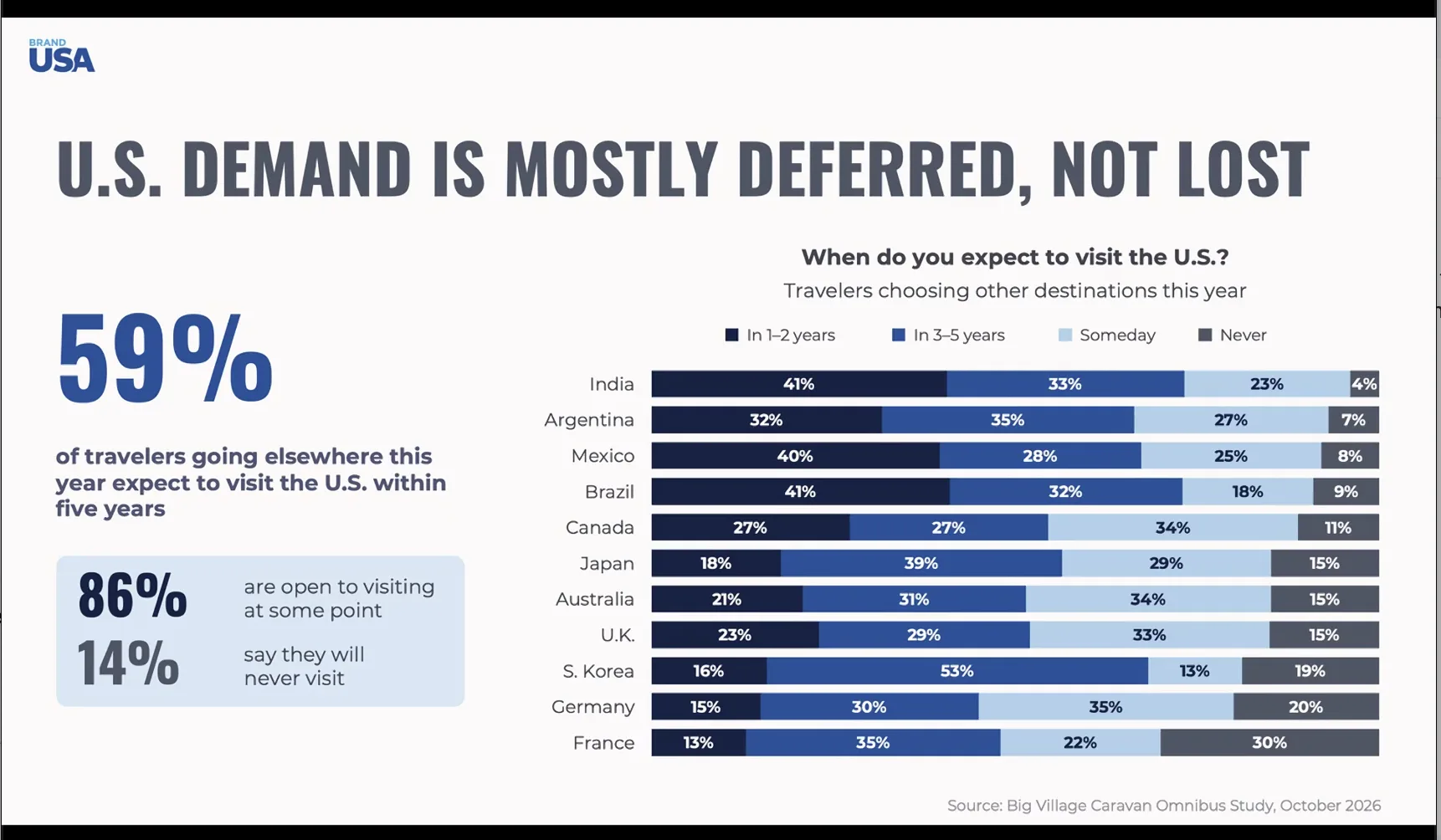
Mostly because Brand USA sees the drop-off from many international markets as deferred – not lost – demand.
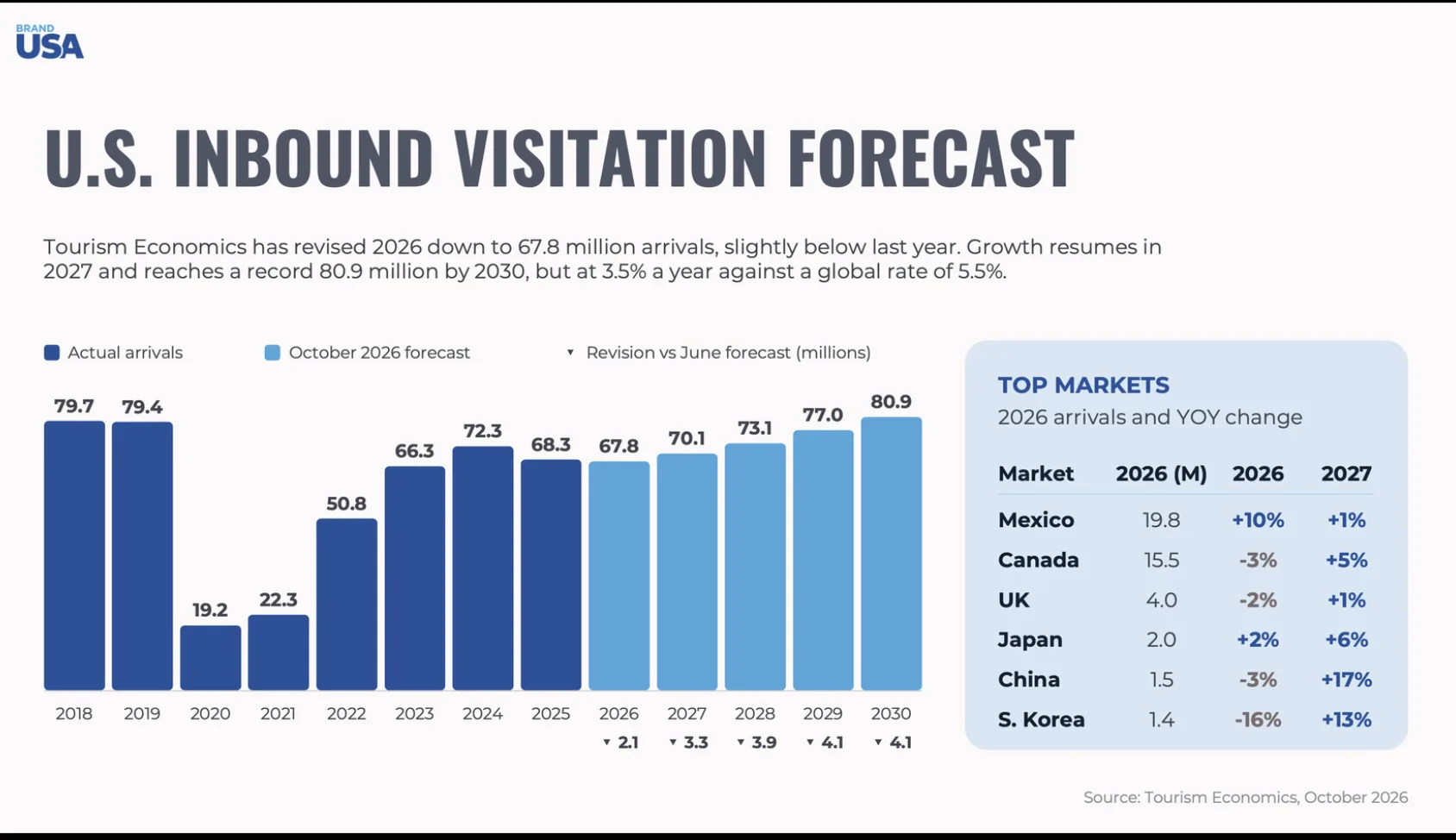
That said, Canada will end 2026 with a 3% drop in visitation to the U.S. That’s year over year, with visitation already down substantially in 2025, for reasons the Canadian travel trade know all too well.
Canada and Mexico, the country’s two largest inbound markets, “are heading in opposite directions. Mexico is expected to finish 2026 up 10%, while Canadian visitation is forecast to decline 3%,” said Chelsea Benitez, Senior Director, Research and Analytics, as she went over the numbers at yesterday’s Brand USA board of directors meeting.
‘POLITICS’ & EXCHANGE RATES
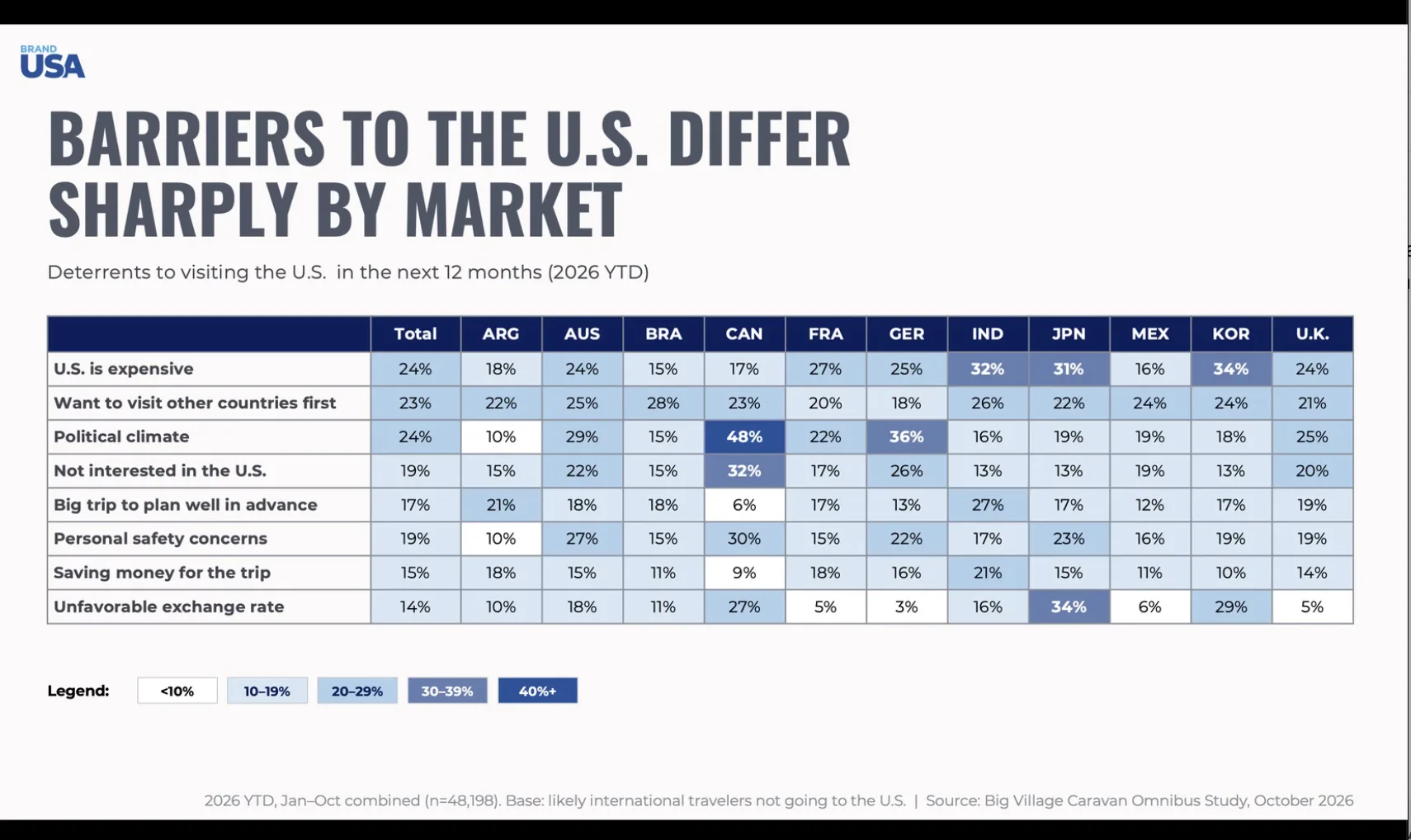
Across all of the U.S.’s biggest inbound markets globally, cost is the number one barrier to visitation, said Benitez.
Meanwhile, from Canada specifically, ‘politics’ is overwhelmingly the top barrier.
“Nearly half of those [Canadian] travellers going elsewhere, cited politics as the reason they’re not visiting the United States, with Germany and Australia behind it,” said Benitez.
For the Asia market, it’s about costs and exchange rates. The U.S. is seen as expensive in South Korea, Japan, and India, “and an unfavourable exchange rate weighs on Japan and South Korea as well as Canada.”
Benitez added that most of the demand “is deferred rather than outright lost.”
The new findings come from Brand USA’s ongoing international sentiment research, which surveys approximately 11,000 people monthly across 11 key markets.
STRONG COMPETITION
The U.S. remains the most considered destination overall across the markets surveyed, although its lead is narrowing, according to the data.
Inbound travel to Japan is booming, and that’s having an impact. In January 2025, the U.S. led Japan by more than eight percentage points in destination consideration. By August and again in October 2026, Japan had moved ahead.
Although Canada has accounted for the largest decline in visitor volume over the past two years, relatively few Canadian respondents say they will never visit the U.S., noted Benitez.
Overall overseas visitation to the U.S. reached 24.1 million through September, a 6% decline compared with the same period last year.
Tourism Economics’ October forecast now projects that international visitation will finish 2026 slightly below 2025 levels, a downgrade from earlier expectations of growth.
Earlier this week the U.S. Travel Association sounded the alarm over declining international tourism to the U.S., with new data projecting an almost US$11 billion drop in visitor spending in 2026.
CANDID CONVERSATIONS
Brand USA’s Chief Marketing Officer, Leah Chandler, said the organization is listening closely to Canadian travellers and travel trade partners to determine how best to rebuild demand in these extremely challenging times for transborder travel.
For Chandler, the next step is turning what Brand USA has learned about Canadian travellers into a marketing initiative that resonates with the market.
Conversations during Travel Week Canada were “candid,” she said.
Rather than making assumptions about which messages will work, she said Brand USA is deep into primary research focused specifically on Canadian travellers.
“We’re building a data-driven solution for Canada that provides a meaningful way for our partners to activate with us,” said Chandler.
More information, including a launch date, will be shared in the coming months, she said.
“The encouraging part is that most of the Canadian travellers we’re targeting are still open to visiting. These are visitors we can win back,” said Chandler.
According to the data, 27% of Canadians choosing other destinations this year said they expect to visit the U.S. within 1 to 2 years. Another 27% said 3 to 5 years. Just over one-third (34%) said “someday”, and 11% said “never.” The survey was published in October 2026, before the 2026 midterm elections’ ‘bluenami.’
For 2027, Brand USA is projecting a 5% YOY increase from Canada.
“SHOWING UP IN MARKET IS ESPECIALLY IMPORTANT RIGHT NOW”
The Oct. 26-29 Travel Week Canada events brought Brand USA’s Canadian travel trade and media engagement under its global Travel Week platform, which already operates in the U.K. and Europe, India and South America.
Malcolm Smith, SVP, Global Markets & Chief Trade and Product Development Officer, said the events are part of a broader commitment to rebuilding relationships with the Canadian travel industry.
Talking about the Canadian edition of Travel Week specifically, Smith said: “Showing up in market is especially important right now.”
This year’s events saw nearly 60 U.S. partner organizations connect with Canadian suppliers, media and other industry professionals in Toronto and Montreal. Smith said the response from Canadian trade partners was “encouraging,” particularly given the challenges facing the market. “We heard directly from Canadian trade and media, who expressed genuine appreciation for our presence and our commitment to the market,” he said.
August 2026 and September 2027 saw back-to-back increases – for both car and air – for Canada-to-U.S. travel, according to Statistics Canada.
“WHERE DID THE LAST 14 YEARS GO?”
Outgoing Brand USA President, Fred Dixon, and interim President and CEO Caroline Beteta, joined yesterday’s meeting.
Dixon’s return to NYC Tourism + Conventions as President and CEO starts Dec. 1.
Meanwhile the incoming Beteta brings a longstanding connection to Brand USA, having previously served as Chair of its Board of Directors and acting CEO. She was also involved in laying the groundwork for the organization’s creation while serving as national chair of the U.S. Travel Association. “Happy to be back. Where did the last 14 years go?” Beteta said with a smile, noting that with each generation, Brand USA “becomes stronger and stronger.”
