





THE HAGUE — More than two dozen passengers left a cruise ship hit by a deadly hantavirus outbreak on April 24 without contact tracing, nearly two weeks after the first passenger died on board, according to Oceanwide Expeditions and Dutch officials.
The news raised concerns that the virus could spread as travellers returned home, although experts say the risk to the wider public is considered low.
The Dutch-based company had previously said the body of the Dutch man who died on April 11 was taken off the ship on the remote South Atlantic island of St. Helena on April 24, when his wife also disembarked. She then flew to South Africa a day later and died there.
The company said Thursday 29 passengers left the vessel at St. Helena, while the Dutch Foreign Ministry put the number at about 40. The company had not previously acknowledged that dozens more people left the ship at that time.
The people who left the ship to return to their home countries were of at least 12 different nationalities, including two Canadians. There were also two people whose nationalities were unknown.
The first confirmed case of hantavirus in a passenger on the ship was only on May 2, the World Health Organization has previously said. That was in a British man evacuated from the ship to South Africa from Ascension Island three days after the St. Helena stop.
Three passengers have died in the outbreak, and several others are sick. Three people, including the ship’s doctor, were evacuated Wednesday while the ship was near the West African island country of Cape Verde and taken to Europe for treatment.
The body of the third fatality, a German woman, is still on board the ship after she died on May 2.
The vessel is now sailing to Spain’s Canary Islands, a voyage that is expected take three or four days, with more than 140 passengers and crew members still on board.
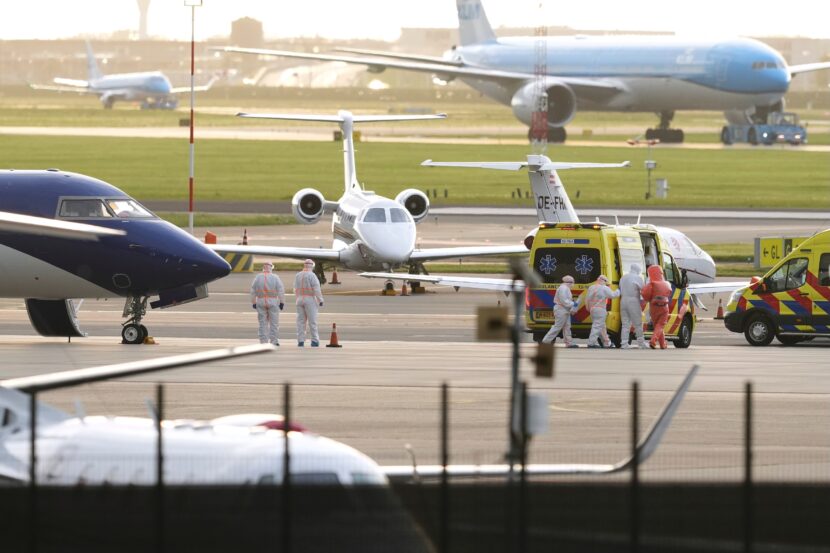
Oceanwide Expeditions posted this update on its site earlier today: “The second of two medicalized aircraft, carrying one of the three individuals transferred from m/v Hondius yesterday (6 May), has landed in the Netherlands. Specialist medical and screening teams have received the individual on board. All three individuals, two symptomatic and one asymptomatic, are now in the care of medical professionals.
“We continue to monitor the progress of m/v Hondius, which departed Cape Verde at 19:15 CET yesterday (6 May) and is sailing for the Canary Islands, specifically the port of Granadilla (Tenerife). This is expected to take 3-4 days. No symptomatic individuals are present on board. Oceanwide Expeditions remains in close and continual discussion with relevant authorities regarding our exact point of arrival, quarantine and screening procedures for all guests, and a precise timeline.”
CONTACT TRACING
Authorities in South Africa and Europe are trying to trace contacts of any passengers who previously got off the ship. It emerged Wednesday that a man tested positive for hantavirus in Switzerland after he also disembarked at St. Helena and flew home, though his precise movements aren’t clear.
Dutch authorities did not confirm where other passengers who disembarked are now.
Hantavirus usually spreads by the inhalation of contaminated rodent droppings and may be transmitted from person to person, though that is rare, according to the World Health Organization, whose top epidemic expert said the risk to the public is low.
Tests have confirmed that at least five people who were on the ship were infected with a hantavirus found in South America, called the Andes virus. It can cause a severe and often fatal lung disease called hantavirus pulmonary syndrome.
Argentina’s health ministry said hantavirus led to 28 deaths nationwide last year, with nearly a third of cases leading to deaths, up from an average mortality rate of 15 in the five years before that.
The Andes strain is the only hantavirus known to spread from human to human.
The ship departed from Argentina and investigations into the source of the outbreak are focusing on that country. The Dutch couple, the first passengers to fall sick, traveled there and elsewhere in South America before boarding the ship, according to WHO.
Lead image caption: Medics escort a patient, evacuated from the MV Hondius cruise ship with suspected hantavirus infection, to an ambulance after being flown to Schiphol airport, May 6, 2026 (AP Photo/Peter Dejong)