





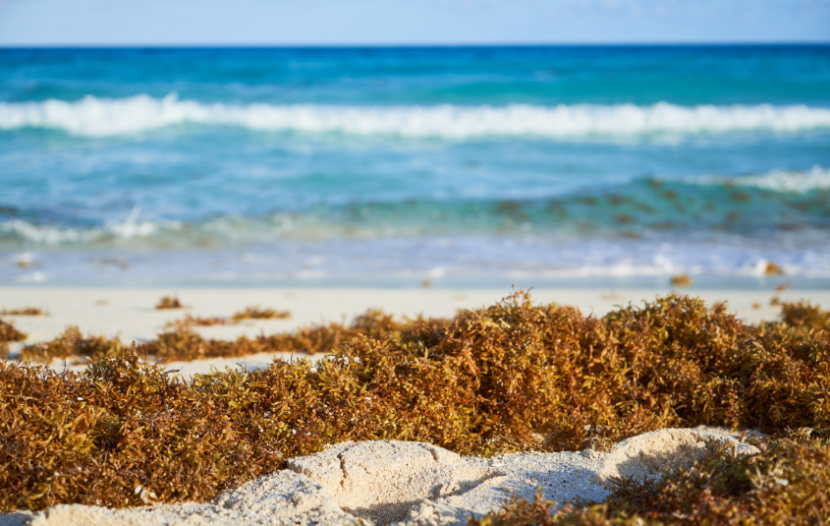
TORONTO — How do you solve a problem like sargassum? Mexico is putting US$115 million into a plan to rid its Caribbean shores of the massive mats of free-floating brown algae – and with some travel advisors reporting diverted bookings to other sun destinations, the plan can’t come soon enough.
Mexico’s new sargassum strategy has two tactical phases. There’s an immediate $44 million to scale collection capacity to 1,870 tons daily – that number alone shows the scope of the problem – using two large tugboats, six sargaceros (sargassum-harvesting vessels) and some 50 kilometres of offshore containment barriers. The second phase, in 2027, will invest the rest of the funds into expanding offshore capture networks with large open-water vessels.
Mexico’s ultimate goal: daily removal capacity for up to 4,000 tons.
Sargassum isn’t a new problem for Mexico, nor is it impacting Mexico alone. Other destinations grappling with sargassum include Barbados, the D.R., Guadeloupe, Martinique and Anguilla, as well as southeast Florida. Sargassum also used to be fairly seasonal, with the worst in the summer. Now the season can stretch from the early months of the year right through the fall.
This also isn’t Mexico’s first investment in fighting the slimy scourge – not by a long shot. For years travellers and the travel industry have watched hard-working resort staff rake and collect sargassum from the beaches. This summer is one of the worst-ever for the stuff. In Quintana Roo, home to Cancun, Tulum and the Riviera Maya, Governor Mara Lezama said dealing with sargassum costs upwards of $2 billion annually, equivalent to 11% of Quintana Roo’s GDP. Last year Governor Lezama announced plans for a facility to convert the tons and tons of sargassum into biofuel. IATA notes that the potential use of sargassum as part of a future sustainable aviation fuel (SAF) value chain could turn a Caribbean challenge into a strategic opportunity.
“The effort so far has been titanic, but we have to do more to prevent sargassum from reaching the beaches,” said Mexicoʻs President, Claudia Sheinbaum, when she announced the National Sargassum Mitigation Plan.
Whatever they’re spending, it’s worth it. Tourism for Mexico is a $30 billion+ industry. Sargassum news coverage and social media posts have potential impact for the whole country, as the average traveller who sees and hears ʻsargassum’ and ʻMexico’ won’t be getting out a map to distinguish between the country’s east and west coast destinations.
On social media, images of sargassum washing up on beaches, as far as the eye can see, are shared worldwide in an instant.
“FOR MANY CLIENTS, THE BEACH IS A HUGE FACTOR”
“I’ve always had clients express concern about the sargassum in the Cancun area,” says TTAND travel advisor Michelle Whalen, adding that clients know about the problem, and look to agents for feedback.
How does she respond? “I tell my clients that sargassum can happen anywhere – it’s nature – and how many of us can control nature? Some clients will want to book the D.R. instead. I don’t necessarily steer them away from Cancun right off the bat – but I do ask them to consider some of the better beaches that traditionally don’t get as much sargassum.”
If some clients are pool people instead of beach people, they may be fine with options in Mexico, Whalen tells Travelweek. But “you still may see and smell the mounds of sargassum from the pool. And who doesn’t feel for the beach staff toiling all day, often hand-shovelling the sargassum?” says Whalen.
She adds: “For many clients the beach is a huge factor, so they will opt for the D.R. most times, or Jamaica. I’m happy to recommend expert advice in those locations but always with the disclaimer they may still encounter sargassum there as well.”
Trevello travel advisor Angela Landry says she leads in with a nature-first perspective too. “Nature should be respected and allowed to do what it needs to do,” she says. “I do get questions about seaweed from clients, and I’m always honest with them. I explain that the ocean is a living ecosystem and that fluctuations, including periods of increased seaweed, are a natural part of that environment.”
Landry adds that in her experience, sargassum is often not a deciding factor when clients are choosing a destination or resort. “Many of my clients spend most of their vacation time around the pool anyway. People are generally aware of it because of the media attention it receives, and they do occasionally ask for my advice. When they do, I provide factual information and help set realistic expectations.”
SIGNAL VS. NOISE
TravRisk Institute Inc.’s Stephen Pike says the actual sargassum situation vs. the media attention is best summed up as ʻSignal vs. Noise.’
“The Signal is the real issue that travellers should understand. The Noise is the volume of commentary that often makes the problem appear larger, more widespread or more predictable than it actually is,” says Pike.
As he puts it, “modern travellers are drowning in information and dying of uncertainty. The challenge isn’t a lack of information. It’s knowing how to interpret it. Sargassum is a legitimate issue. It can affect beach quality, create unpleasant odours, impact marine ecosystems and, in some circumstances, present health concerns. At the same time, headlines and social media can sometimes leave travellers with the impression that an entire destination has become unusable, when the reality is often far more localized, seasonal and constantly changing.”
And something like sargassum is where where travel advisors provide enormous value, he adds.
“It reinforces the evolving role of the travel advisor. Today clients can find unlimited information online in seconds. What they can’t easily find is context, judgment and perspective. The advisor’s value isn’t simply providing information – it’s helping travellers understand what matters, what doesn’t, and how to make confident, informed decisions.”
Mexico’s investment to address sargassum is also encouraging, says Pike. “Whether every aspect of the initiative succeeds remains to be seen, but it’s a positive sign that the country is treating the issue as something to be actively managed rather than simply reacted to.”
In the end, he says, good travel advice isn’t about dismissing risks or amplifying them. “It’s about separating the Signal from the Noise so travellers can enjoy their trip with realistic expectations and confidence.”
