


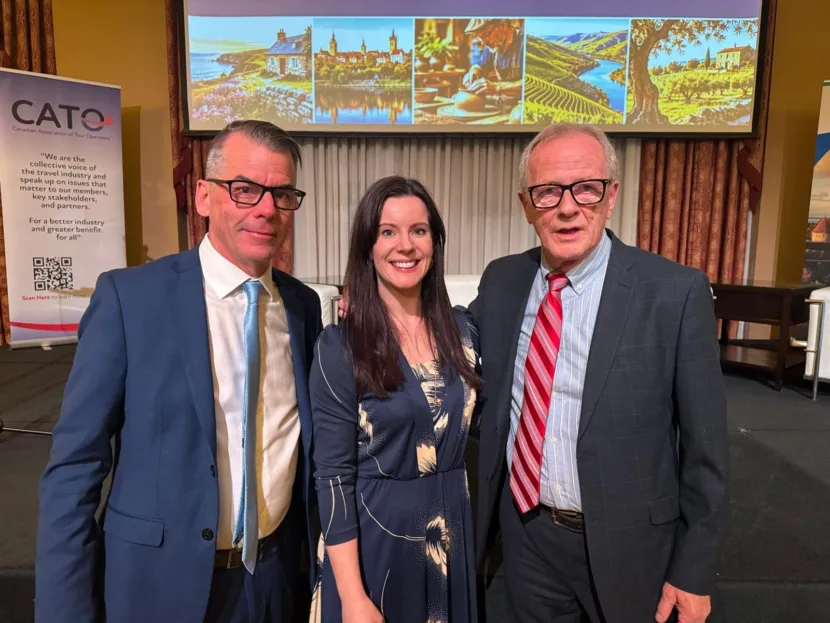
HAMILTON — September is the new August for Canadians heading to Europe, according to a message delivered at the European Travel Commission (ETC) and Canadian Association of Tour Operators’ (CATO) recent industry gathering — and the opportunity for travel advisors extends well beyond a change of departure date.
At the organizations’ Nov. 18 ‘Unlock an Unexpected Upgrade’ event at Liuna Station in Hamilton, the focus was on helping travellers discover a different side of Europe through off-peak trips, lesser-known destinations, greener transportation and closer connections with local communities.
For CATO Chair Brett Walker, those choices make sense not only for destinations, but also for the businesses selling them.
“The reason we’re here is because these things we’re talking about tonight are really good for business,” said Walker.
He pointed to opportunities for product and regional development when travellers venture beyond familiar routes, along with greater community engagement through smaller-group experiences. Extending the travel season can also help reduce the seasonal nature of employment, both in destinations and among the tour operators serving them.
The challenge, Walker said, is making travellers aware of the options available across Europe throughout the year.
“It’s all about education, and that’s what tonight is all about,” he said.
Walker also emphasized the value of collaboration among companies that otherwise compete for the same customers. While CATO members may be rivals in the marketplace, he said, issues such as climate action, human welfare and industry advocacy benefit from a collective approach.
“There are certain issues which we are utterly committed to as a team, as a group, as an organization,” he said.
HELPING TO STRETCH THE SEASON
That collaborative approach underpins ETC’s ‘Unlock an Unexpected Upgrade’ campaign, which presents responsible travel as a way to gain a more rewarding holiday rather than give something up. Its four central behaviours are travel off-peak, go offbeat, travel green and love local.
“September is the new August,” said Matteo Nardin, Marketing Project Manager with ETC, in his presentation to the trade.
According to the presentation, Canadians are increasingly choosing September over the summer peak, while October is growing faster than any summer month. Nardin also pointed to Air Canada schedules extending into October as a factor supporting that shift.
For advisors, ETC’s message was to build and promote September and October itineraries as air capacity helps stretch the season.
The broader objective, Nardin explained, is to encourage travel that delivers benefits for visitors while easing pressure on local communities, infrastructure and ecosystems.
“We want to aim for value and not just for volume,” he said.
Travelling outside peak periods can mean fewer crowds and, in some cases, lower prices. Exploring beyond the busiest gateways can introduce clients to destinations they might otherwise overlook, while rail journeys and hands-on local experiences can become memorable parts of the holiday themselves.
21% OF CANADIAN TRAVELLERS PLAN FOR 11+ DAYS
The Canadian market offers particular opportunities for that approach. ETC’s presentation showed that 21% of Canadians plan a typical trip of 11 days or more. Among Canadians intending to visit Europe, 53% were returning visitors, compared with 47% across all markets.
Nardin noted that repeat visits and longer stays create room to explore beyond the best-known cities. A client returning to Europe does not necessarily need to abandon Paris, London or Rome; an extended itinerary can introduce neighbouring regions or another country.
Convenience remains important, however. The presentation identified air connectivity, along with ease and convenience, as key considerations for Canadians choosing a destination. Its message for secondary destinations was to make the journey feel straightforward through smooth connections and simple logistics.
ETC also highlighted an important distinction between travelling offbeat and travelling off-season. During peak periods, lesser-known destinations can offer an alternative to the busiest attractions. Outside peak periods, major cities and popular sights may become more appealing.
FOUR SELLING TIPS
The aim is to find the balance between somewhere that feels atmospheric with fewer crowds and somewhere that feels empty or deserted.
For advisors translating those ideas into sales conversations, the presentation offered four practical prompts: price can outweigh concerns about shoulder-season weather; rail should be sold as part of the experience rather than time lost in transit; electric-vehicle itineraries require charging plans; and hands-on experiences with local people can add depth to a stay.
The Hamilton event’s programme reflected that emphasis on discovery, with European experiences ranging from Czechia’s traditional blueprint artistry and Irish music to Belgian chocolate and Spanish tapas.
The tour operator lineup included Collette, TravelBrands, G Adventures, Globus family of brands, Goway, Railbookers, Royal Irish Tours, Trafalgar and WorldStrides.
For Wayne MacArthur, a travel advisor with Lapierre Travel who has spent 27 years in the industry, the appetite for off-season Europe is already evident among his clients.
He said a number of customers choose quieter travel periods for the combination of fewer tourists, somewhat lower prices and a more relaxed experience.
“They don’t have the pressure of all the people around them,” he said.
Asked which months are proving popular, MacArthur pointed beyond the traditional June-to-August window.
“It’s now September, October, November,” he said.
Europe remains a strong part of his business, with the Baltic states drawing particularly enthusiastic feedback. Clients return impressed by the scenery, people and food, he said, while travelling by train adds to the appeal.
“They go by train, and they just absolutely love it,” said MacArthur.
Repeat business is another important part of the picture. Many of his clients want to return to places they have already enjoyed, giving advisors an opportunity to continue the conversation about when to visit and how to experience a destination differently.
And while timing, price and transportation all matter, MacArthur said the welcome travellers receive remains one of Europe’s most dependable selling points.
“They’re so friendly, they’re willing to help out, which adds to their adventure,” he said.
Lead image caption: CATO’s Brett Walker, Sandra Moffatt and Jean Hébert
