





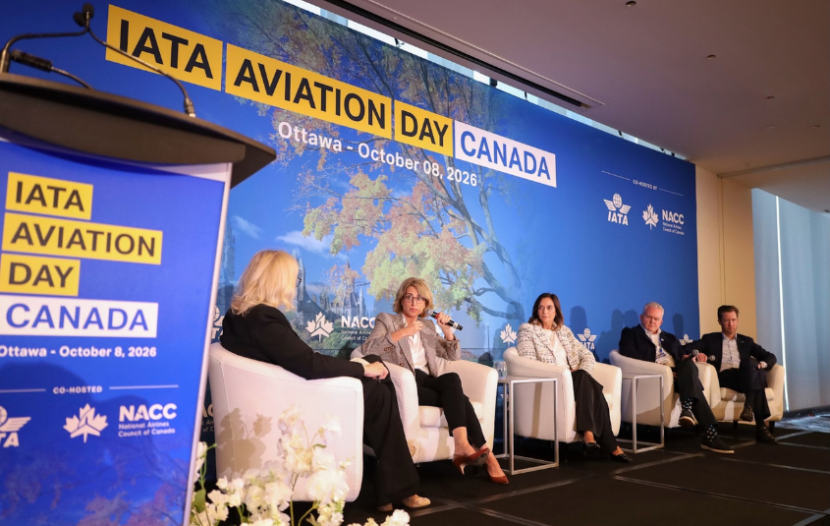
TORONTO — There’s no shortage of hot topics in the Canadian aviation industry these days – and the Air Canada, WestJet, Air Transat and Porter execs who took part in IATA Aviation Day Canada’s Airline Leadership Roundtable were game to take them on.
Labour relations and the recent strikes. Fees. Privatization. The APPR. Jet fuel costs and airfare prices. The roundtable discussion at IATA’s annual Ottawa event yesterday touched on them all.
Airport privatization? “The objective should not primarily be to create funds for a national wealth fund. The objective should be to create a system that improves affordability for Canadians, because we’re operating among the most expensive airports in the world,” said WestJet Group CEO, Alexis von Hoensbroech at yesterday’s event.
Canada currently ranks 105th out of 119 countries when it comes to aviation affordability, he said. “That’s a problem.”
Transport Minister Steven MacKinnon told reporters “we will regulate through contract. Those concessions will contain price moderation, if I can call it that, or fee moderation.”
Von Hoensbroech said the fee framework needs to be right before moving ahead. “An airport is a local monopoly [and] you have to regulate passenger fees. The privatized airport can make its money on retail and real estate. It’s a system that can work very well. But it needs to start with [fee] regulation.”
Air Transat’s President and CEO, Annick Guérard, cut right to the chase: “If it’s just a question of replacing a public monopoly with a more expensive private monopoly, then we don’t support it.”
Last month the federal government said its plan to open Canada’s four largest airports – Toronto Pearson, Montreal, Calgary and Vancouver – to private investors will mean federal spending on the major airports’ operating costs can be shifted towards smaller regional airports and other infrastructure projects. The federal government would retain ownership of the land and assets.
In the morning session’s opening address, Minister MacKinnon said he knows “there are a lot of questions about what comes next. These are major national assets.” He said no decision has been made on the sequencing of the process that will identify the concessions and operating models at the four airports.
According to The Globe and Mail, sources say Vancouver International Airport is first up for privatization.
“When you look at all the charges, about a third of the cost of a domestic ticket never gets seen by the airline. And that isn’t competitive either,” said Air Canada EVP and Chief Human Resources Officer and Public Affairs, Arielle Meloul-Wechsler.

Arielle Meloul-Wechsler, EVP and Chief Human Resources Officer and Public Affairs, Air Canada
GEOPOLITICAL SHOCK #1: U.S. DEMAND
While the what-now’s of airport privatization simmer on the back burner, Canada’s airlines – and the travel industry – are dealing with the more immediate impact of global geopolitical shocks, on what feels like a day-to-day basis.
“Every time you think it can’t get more complicated, it gets more complicated,” said Meloul-Wechsler.
Von Hoensbroech said WestJet’s Canadian-origin demand into the U.S. dropped by 25% to 30% over the past 18 months, “and it hasn’t recovered at all.”
Essentially cross-border discretionary travel has largely disappeared, he added. “We’re seeing certain destinations, like Las Vegas, for instance, down 60% compared to where they were before. People are now going camping instead of spending money in a Las Vegas casino.”
Guérard said Air Transat’s shift away from U.S. sun destinations is seeing more passengers head to the Caribbean. “We’ve seen traffic moving from the United States to the Dominican Republic, for instance, to Costa Rica and to Mexico. There are destinations in Spain that are attractive year-round, where people might switch from going to the U.S., Florida for instance, and go somewhere like Malaga instead.”
“I would say that a lot of people who are used to going to the U.S. are simply deciding not to travel,” she added.
GEOPOLITICAL SHOCK #2: CUBA
Guérard was also candid on Cuba. Air Transat along with WestJet and Air Canada repatriated thousands of travellers back to Canada in early February. “It was extremely difficult for us. When these kinds of shocks happen in the airline industry, you don’t have the ability or the luxury of adapting gradually. It’s like rebuilding a highway while traffic is still running on it. In a matter of days we needed to redeploy aircraft, redeploy capacity, redeploy our staff to the right places, redefine the schedule and protect all the passengers who were affected.”
There’s also the ongoing impact of a favourite Canadian winter sun destination completely sidelined.
WestJet Group was flying more travellers to Cuba than all other airlines worldwide combined, said von Hoensbroech. “Cuba was a big stronghold for us. So it’s tough.”
GEOPOLITICAL SHOCK #3: JET FUEL COSTS & HIGHER AIRFARES
By far the biggest disruption for the airlines in 2026: the soaring cost of jet fuel as a result of the Iran war.
“The fuel price has more than doubled. That’s absolutely crazy, and it puts a lot of pressure on airlines,” said Von Hoensbroech.
“Fuel normally represents about 20% to 25% of an airline’s cost structure. If fuel prices double, that essentially means your cost structure goes up by 20% to 25%. Which means your ticket prices have to go up by 20% to 25%, on average. That’s a lot, and that’s the reality we’re facing. At the end of the day, airlines need to pass on their operating costs through ticket prices, and that has a direct impact on Canadians.”
Guérard said Air Transat’s decision to cancel some new destinations, in an effort to remove capacity because of fuel costs, was “very tough. Some flights were no longer covering their variable costs.”
LOANS & FOREIGN OWNERSHIP CAPS
Both Air Transat and Porter secured loans from the federal government as sharply higher jet fuel prices put added pressure on airline operating costs. Transat’s loan is worth $400 million, and Porter’s is $125 million.
This past summer Air Canada it would not need to draw on the new aid, while WestJet has said it strongly opposes the loans because of its market-distorting effects.
“We were very happy that the government came forward with the loan program. We were in a crisis. And even though not everybody agrees with the program that was put in place, I think it was a necessary measure to protect competition and to protect customers – and travel overall,” said Guérard. “If it weren’t for those programs, I would say maybe two people wouldn’t be sitting here today.”
Having an almost exclusively leisure base has an impact, she added. “It’s really difficult to pass on increased costs to passengers in a short period of time. They’re price-sensitive. Ultra-low-cost carriers and small and medium-sized airlines are much more exposed to all these shocks that happen in the industry.”
Guérard said Air Transat is in favour of eased rules around foreign ownership caps for Canada’s airlines.
“There are other crazy people outside Canada who are willing to take the risk. I think that would be beneficial for the country, beneficial for competition and beneficial for affordability,” she said.
In 2025 the Competition Bureau released 10 recommendations to bolster Canada’s aviation industry, including an increase the single-investor foreign ownership limit for Canadian airlines to 49%, and up to 100% foreign ownership for domestic-only Canadian airlines.
“I don’t think anybody knows better than the people sitting on this stage just how critical access to capital is. It’s extremely important, and Canada has a limited pool of capital. We would like to see this opened up,” said Guérard.
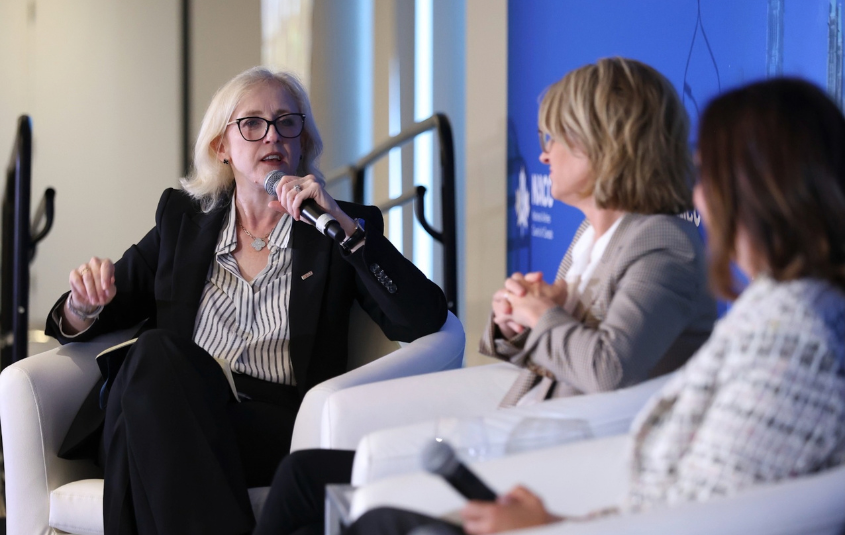
Lisa Raitt moderated IATA Aviation Day Canada’s Airline Leadership Roundtable
APPR
Canada introduced the Air Passenger Protection Regulations (APPR) in 2019. Earlier this year the CTA’s backlog of complaints neared the 100,000 mark.
The carriers are bearing the full cost of APPR, “and yet we’re the face of the system for consumers when things go wrong, even when those things are outside our control,” said Porter’s President, Kevin Jackson. “We have no ability today to recoup those costs from partners across the aviation system. The entire industry should share that incentive because it would make the whole process better for consumers.”
Air Canada’s Meloul-Wechsler said APPR “is no longer fit for purpose.” This past spring Air Canada began testing a third-party process for resolving compensation claims.
“We gave our customers a choice, with no obligation, to have their complaint reviewed by an independent third-party firm in a very efficient manner,” said Meloul-Wechsler.
This is potentially a model for the government to follow, she noted. “They’ve announced that they’re looking at doing something similar, which could greatly reduce the backlog and, more importantly, improve the efficiency of processing complaints. I understand APPR will probably never go away, but it certainly shouldn’t be expanded. We shouldn’t be looking at more ways to penalize airlines. We shouldn’t assume airlines don’t want to pay when they do something wrong.”
Guérard said airlines shouldn’t be seen as the insurer for the entire aviation ecosystem. “Is it a mechanical issue? Is it the weather? Who’s responsible? We’re wasting so much time on these questions. And when you look at the level of complaints with the Canadian Transportation Agency, it’s become something that’s unmanageable.”
LABOUR UNREST & STRIKES
Strikes by Air Canada’s flight attendants in August 2025, and WestJet’s flight attendants in August 2026, saw Canadian travellers impacted by two work stoppages at Canada’s two biggest carriers in less than one year.
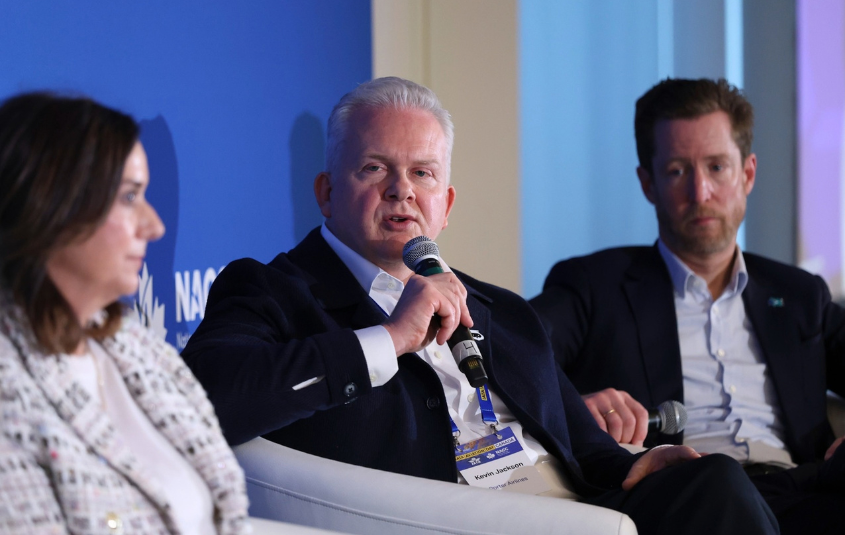
Kevin Jackson, President, Porter Airlines
“One single labour dispute can put an airline on the ground,” said Guérard. “We have other teams that are not unionized that we’re giving 2%, 3% pay increases because we don’t have any more money, because it’s all going to the unionized teams. We need to rebalance the power… [and make sure] companies remain viable.”
She added: “With the pandemic, at the time, we had to let go of 80% of the workforce. When they came back there was a bit of a sense of ‘it’s payback time.’”
Moderator Lisa Raitt praised WestJet for getting back on track so quickly after this summer’s strike.
“The team did a tremendous job,” said Von Hoensbroech. “Unfortunately we’re well trained in this, which is a sign there’s a problem. There’s a level of frustration here. The last five years have seen much more labour disruption than the 20 years before. It’s a major challenge. Labour relations are super important. I truly believe it has to be possible to work with unions as partners and not as antagonists.”
He said WestJet knew a new deal was needed. “We had a very good idea what we had to offer our flight attendants. They accepted it with a 90% yes vote. We offered it before the strike. Do you put more than 100,000 Canadians and their families in jeopardy on an August long weekend just because you can? I think that’s a problem. … This kind of performative strike is not why the right to strike exists.”
Bill C-39 would amend the Canada Labour Code to give the Jobs Minister more authority to intervene in or halt labour disputes and strikes when the ‘national interest’ is deemed at risk. The bill has its detractors, including the Canadian Labour Congress, which argues the Canadian government would gain broader unilateral power to end a legal strike “than exists in any other G7 country.” The bill cleared second reading in the House of Commons this week.
When the strike countdown is on and tensions are high, “the narrative takes over because the narrative sells. Some of this is the balance of power has shifted and there’s a little bit of gamesmanship that happens. Transparency will be key,” said Meloul-Wechsler.
Lead image caption: Speaking with moderator Lisa Raitt (far left) at IATA Aviation Day Canada’s Airline Leadership Roundtable in Ottawa are Annick Guérard,President and CEO, Air Transat; Arielle Meloul-Wechsler, EVP and Chief Human Resources Officer and Public Affairs, Air Canada; Kevin Jackson, President, Porter Airlines; and WestJet Group CEO, Alexis von Hoensbroech (all photos courtesy IATA)
