


MONTREAL — Sky-high fuel costs pushed Air Canada to slash its profit forecast by hundreds of millions of dollars for the year after a turbulent quarter that saw its bottom line nearly cut in half.
The country’s largest airline recovered less than half of its fuel expanse last quarter, but aims to recoup about 70% in the current one, said CFO John Di Bert in yesterday’s Q3 results conference call.
Fuel costs for Q3 2026 exceeded $2.1 billion. The year-over-year fuel cost increase was 75% or $906 million in the three months ended Sept. 30.
For the first nine months of 2026, Air Canada spent more than $5 billion on fuel, compared to $3.5 billion in the first nine months of 2025.
“WITH US FOR THE FORESEEABLE FUTURE”
Amid the ongoing conflict in the Middle East that has throttled global oil exports, Di Bert expects the fuel price to hover around $1.72 per litre — “significantly higher than originally planned.”
“That is with us for at least the foreseeable future,” he said.
As a result, passengers can expect more ticket price hikes.
“Fare increases remain the primary tool to offset a higher fuel environment,” he said.
Airfares in Canada rose 19.4% year-over-year in September, according to Statistics Canada.
Air Canada lowered its 2026 financial outlook on Thursday, forecasting between $2.4 billion and $2.7 billion in earnings before interest, taxes, depreciation and amortization, versus the $2.9 billion to $3.2 billion it predicted less than three months ago.
However operating revenues jumped 21% to a third-quarter record of $6.98 billion, as the airline ratcheted up airfares.
LONG HAUL VS. SHORT HAUL
The financial clouds on the near horizon relate partly to the lag between bookings and fuel prices, said CCO Mark Galardo.
Air Canada has a much higher proportion of long-haul to short-haul flights than its U.S. competitors. Those longer trips are generally booked further in advance, at prices that reflect the fuel price expectations at that time.
“Once those bookings are in, it’s hard to recapture (fuel costs),” Galardo noted.
National Bank analyst Cameron Doerksen said that while the timeline to full cost recovery “has been pushed to the right,” complete recuperation would be possible in the first half of next year.
“We believe that higher fuel costs are weighing more heavily on the profitability of Air Canada’s competitors, which ultimately will lead to more industry capacity cuts to the benefit of Air Canada,” he said in a note to investors.
“NO REASON TO BE CONCERNED ABOUT THE STATE OF THE TRANSBORDER MARKET”
The sustained decline in demand for travel to the United States has pushed the carrier to scale back its cross-border service. Earlier this year, it halted or delayed eight transborder routes for the fall, then cut four more routes planned for this summer.
Canadians’ return trips by air from the U.S. numbered 23% fewer in August than the same month two years earlier, according to Statistics Canada.
In the same period, Air Canada flight volumes between the two countries fell 13%, figures from aviation data tracker Cirium show.
However, Galardo has cautioned against reading too much into cuts to some of its cross-border corridors, noting several routes had been added as well.
He said the strength of the U.S. dollar, higher profit margins south of the border and growing American demand for trips to Canada all provide tailwinds. Air Canada is also seeking to leverage the country’s location as a stopover point for Europeans and North and South Americans who cross the Atlantic Ocean.
“I’ve got no reason to be concerned about the state of the transborder market,” Galardo said.
NETWORK EXPANSION
Air Canada has embarked on a major expansion of its network overseas, announcing last month seven new routes in Europe and Asia for next summer.
Driving the expansion are new long-range Airbus A321 single-aisle jets as well as Boeing 787 wide-bodies, though major delivery delays have hampered their rollout.
The first of an expected 30 Airbus A321XLRs arrived at Air Canada in April. Six more of the fuel-efficient single-aisle aircraft — many bound for transatlantic service — are set for delivery this quarter. Its first two 787-10s are due before the end of the year as well, on top of seven Airbus A220s — smaller narrow-bodies assembled north of Montreal — Di Bert said.
The A321s jets burn 15 – 20% less fuel than wide-body planes on trips across the Atlantic, he said. “This is meaningful in any environment, but it matters even more in this current fuel environment.”
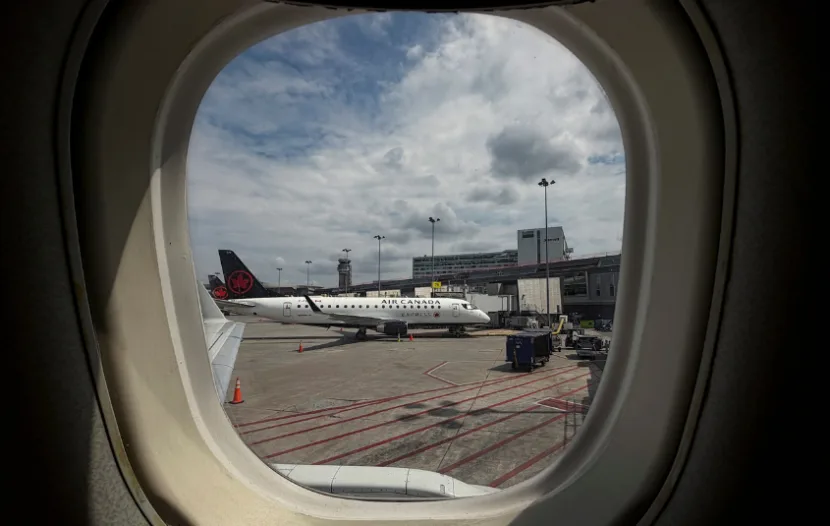
Lead image caption: An Air Canada plane sits by its gate as it waits to depart Montreal-Trudeau International Airport on July 30, 2026 (The Canadian Press / Christinne Muschi)