





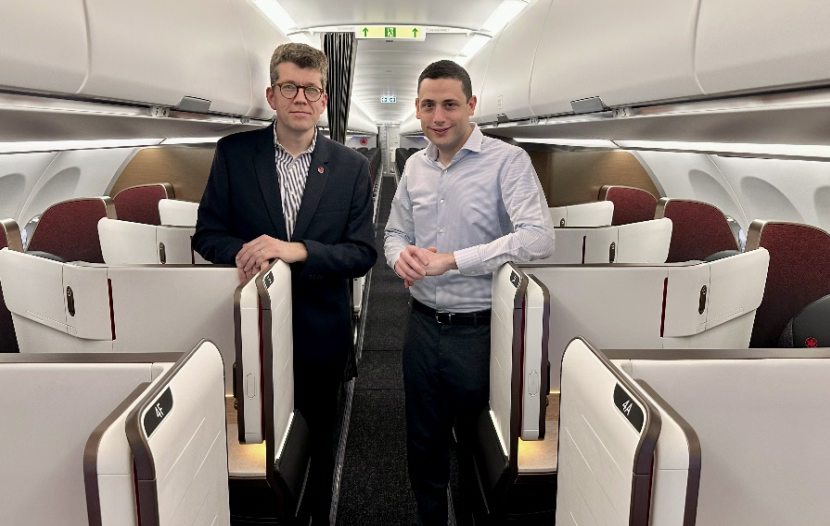
MONTREAL — It was at Air Canada’s headquarters, near Montreal-Trudeau International Airport, that we had the privilege of discovering the Airbus A321XLR for the first time.
This next-generation aircraft – the Canadian carrier’s latest acquisition as part of its fleet renewal – combines comfort, technology and innovation. A true showcase of Airbus’ expertise, it will allow passengers to enjoy a unique experience aboard a single-aisle aircraft.
“I am extremely proud of the product we are offering,” said Mark Nasr, Air Canada’s EVP and Chief Operating Officer. “Our goal was to offer our customers a travel experience on par with what we usually offer on our long-haul, wide-body flights across the Atlantic. There was no way the experience aboard the A321XLR would fall short of our standards.”
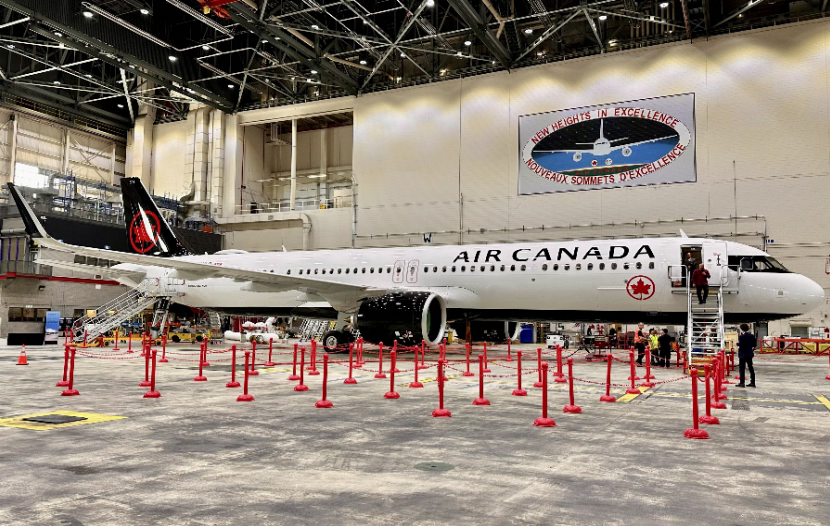
Air Canada invited the media to its headquarters to discover the A321XLR ©Malik Cocherel
A MAJOR FIRST
With a capacity of 182 seats (14 in Business class, 168 in Economy class ), the aircraft offers a quieter and more comfortable cabin, designed to promote passenger well-being through a calming and friendly atmosphere.
The arrival of this new aircraft coincides with the introduction of new cabins designed according to Air Canada’s ‘Warm Welcome’ concept, which focuses on contemporary design, high-end materials and an enhanced travel experience.
At the front of the aircraft, Air Canada’s Signature Class features 14 fully reclining lie-flat seats, a first on a single -aisle aircraft in the carrier’s fleet. Each suite offers enhanced privacy thanks to a sliding partition and is equipped with a state-of-the-art entertainment system featuring a 48 cm 4K OLED screen, Bluetooth connectivity and customizable ambient lighting.
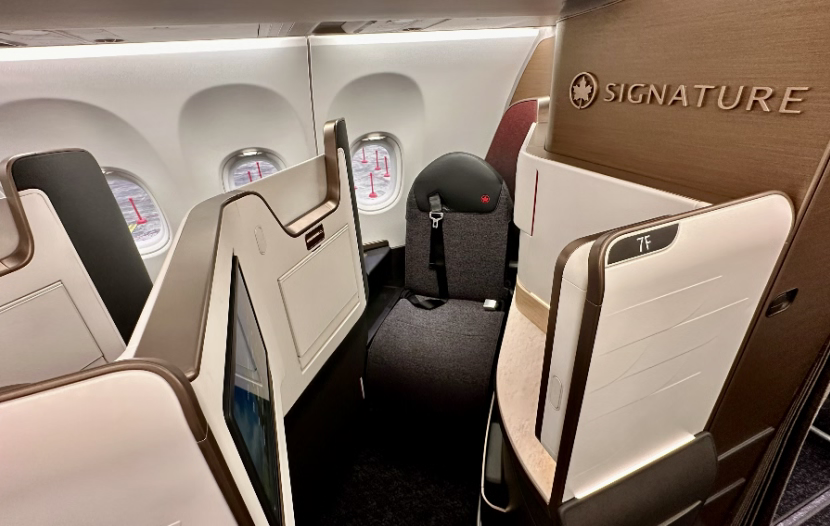
The 182-seat aircraft features 14 fully reclining lie-flat seats, a first for a single-aisle aircraft in the carrier’s fleet. ©Malik Cocherel
SPACE FOR EVERYONE
In Economy cabins, comfort is also a priority with new ergonomic seats designed to optimize personal space and enhance the travel experience.
The aircraft offers 36 Preference+ seats, providing more legroom. The entertainment system includes a 33cm 4K OLED screen, Bluetooth connectivity and USB-C ports, plus a fold- out tablet with integrated stand and smart storage for personal belongings and electronic devices.
Storage space is one of the A321XLR’s strong points, with particularly generous overhead bins. “They’re the largest in the industry; you can store up to six rolling suitcases in each compartment,” says Nasr, adding that every detail of the cabin has been optimized. “We’ve thought of every inch of the Economy cabin. We offer more space at every seat in Economy compared to our competitors in Canada. We’re a premium airline at every level, not just in Business Class.”
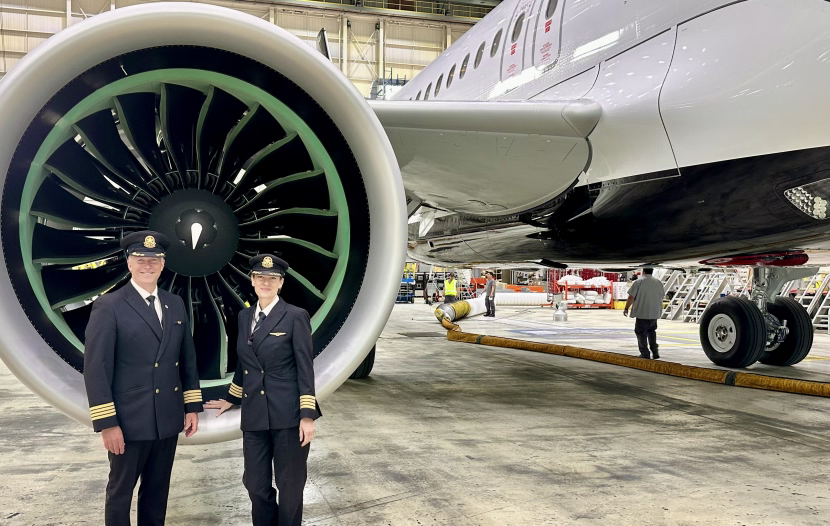
The A321XLR will make its inaugural flight on June 15 on the Montreal–Toulouse route ©Malik Cocherel
INCREASED ENERGY EFFICIENCY
The A321XLR will take off June 9 bound for Toronto, before making its inaugural flight on June 15 on the Montreal-Toulouse route.
“One of the key elements of this aircraft, which makes it particularly attractive, is its performance,” says Alexandre Lefèvre, VP, Network Planning and Global Sales at Air Canada. “It can fly much farther than our current single-aisle fleet, which allows us to consider transatlantic routes that an aircraft of this category could not operate, and certainly not in such comfortable conditions.”
This performance is accompanied by a reduced fuel consumption of approximately 25% at equivalent capacity, an energy efficiency that has become essential in the current crisis context.
“It was a determining factor during the acquisition, and it’s even more so today,” insists Lefèvre.
After Montreal–Toulouse, the A321XLR will be deployed to Berlin, Nantes, Porto and Tenerife starting at the end of October.
DELIVERY DELAYS
The airline notes that even if some delivery delays are anticipated, the delays shouldn’t significantly alter the delivery schedule.
As Nasr told Reuters: “On the XLR program, unfortunately, we have been on the receiving end of several delays in the program, and these aircraft are, you know, the better part of two years late from what we originally anticipated when we made the order.”
Nasr added: “It’s not specific to anyone, but there is still friction in the system and we’ve had to adopt our business to be candidly much more flexible.”
Other airlines impacted by Airbus’ A321-XLR delivery delays include American Airlines and United Airlines.
“It’s important to remember that this is the first aircraft in a firm order for 30 planes,” adds Lefèvre. “Some of these aircraft will also be allocated to the North American network. This will allow us to operate flights between Montreal, Toronto, Vancouver, Calgary, Los Angeles and San Francisco, to name just a few.”
Lead image caption: Mark Nasr, Air Canada, EVP and Chief Operating Officer (right) and Alexandre Lefèvre, Air Canada, VP Network Planning and Global Sales (left) (all photos courtesy Malik Cocherel)
With file from Travelweek