


TORONTO — “Automate the predictable so you can humanize the exceptional.”
It’s one of Virtuoso Chairman and CEO Matthew Upchurch’s most frequently quoted philosophies, and it’s especially relevant amid today’s AI trends.
As AI moves further into the travel booking process, Upchurch says he believes the real value of a travel advisor will become even clearer. And he’s more optimistic than ever about the human side of the business.
But he cautions against assuming that being human automatically makes someone good at the human side of the business. “The work on the human side is every bit as serious and needs as much diligence as anything on the technology side.”
FIRESIDE CHAT AT TRAVEL TRENDS SUMMIT V3
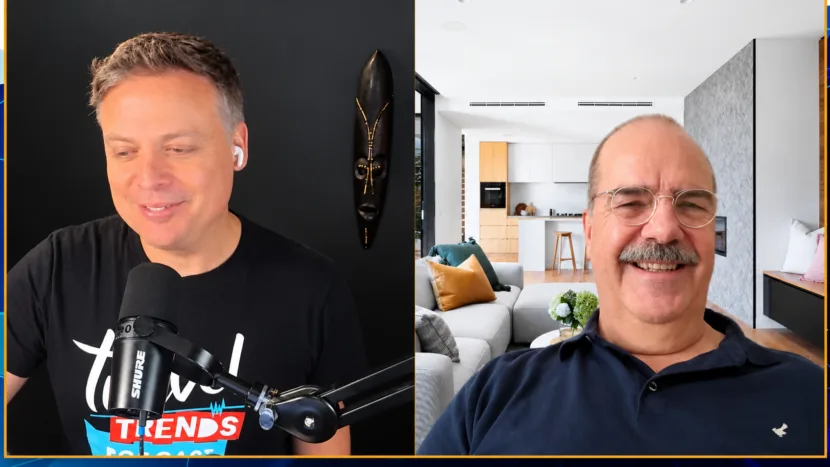
Speaking with Travel Trends host Dan Christian yesterday during the closing fireside chat at the Travel Trends Summit V3, Upchurch shared his perspective on where technology is headed, why human relationships matter and what the industry can expect in the years ahead.
The conversation, ‘Where Humans are Relevant in the Age of AI,’ capped the two-day virtual Travel Trends summit, with title sponsor TourRadar. Day 1 focused on technology and distribution, while Day 2 turned to marketing, leadership and the human advantage.
“GREAT TRAVEL ADVISORS HAVE NEVER BEEN JUST ABOUT THE BOOKING”
For Upchurch, the distinction between booking a trip and being a travel advisor is fundamental.
“Booking the travel. I mean, that’s the red ocean,” he said, talking about the intensely competitive space where technology companies and travel sellers are concentrating much of their attention.
“And great travel advisors have never been just about the booking. I mean, obviously, you got to get it right. But it’s always been about how do you add value before travel, during travel, and after travel.”
Virtuoso has data showing that what happens after a trip is the single biggest differentiator between a transactional relationship and one that delivers continuing value.
“If it becomes a learning relationship, if that interaction, that relationship enhances the future, then it’s a learning relationship,” he said.
Upchurch went back to the predictions of travel advisors’ demise during the online travel agency revolution of the late 1990s, followed by another round of predictions with the arrival of mobile technology and Millennials.
“If you were a human ATM, you were gone,” he said of the early online booking era.
But the advisor business survived, and Upchurch says it has only grown stronger with millennials and Gen Z. Why? Because the fundamentals of a valuable advisory relationship haven’t changed.
“It’s not just what you know, but who you know. It’s about how you make me feel,” he said.
THE REAL VALUE OF ASKING QUESTIONS
Upchurch says he’s increasingly seeing Virtuoso members become more deliberate about how they communicate and the questions they ask.
He recalled telling USA Today that in an era when information is readily available, clients don’t necessarily value advisors for having all the answers. The real value can come from asking an interesting question.
“Today we call that prompt engineering, right?” he says. “Like anybody knows that the quality of what you get out of AI is directly correlated with questions that you ask.”
He said the next phase of technology development will become far more individualized. The Virtuoso Travel Technology Summit, launched about five years ago with some 60 or 70 participants, attracted more than 800 this year. Upchurch said the event has become a gathering place for technology companies, investors and entrepreneurs focused on enhancing human expertise rather than replacing it.
“I believe that the way technology is going to be designed, implemented, whatever you want to call it, is going to become as personal as relationships,” he said.
And rather than everyone working through one platform, he said he sees technology adapting to the individual.
THE BEST THINGS AREN’T OPTIMIZED
Upchurch’s confidence in the human advantage isn’t new.
He told Christian how he grew up around the evolution of computing, and said he made an early career choice to view technology as something that serves people, rather than competes with them.
He added: ”I wonder if the things that actually become valuable are the things that are purposely not optimized, or the things that are purposely not automated.”
Upchurch said he believes advisors who use technology effectively will also need to become more sophisticated about identifying exactly where they create value for their clients.
“The humans who leverage technology are going to have to become as sophisticated in the way in which they identify, connect emotionally and otherwise with their customers in an era where everybody is trying to optimize everything,” he said.
The biggest opportunity might lie in knowing when not to optimize.
“The opposite of optimization is not inefficiency or not optimized. It actually could be exactly where value lives.”
Lead image caption: Travel Trends founder Dan Christian and Virtuoso Chairman and CEO Matthew Upchurch
