





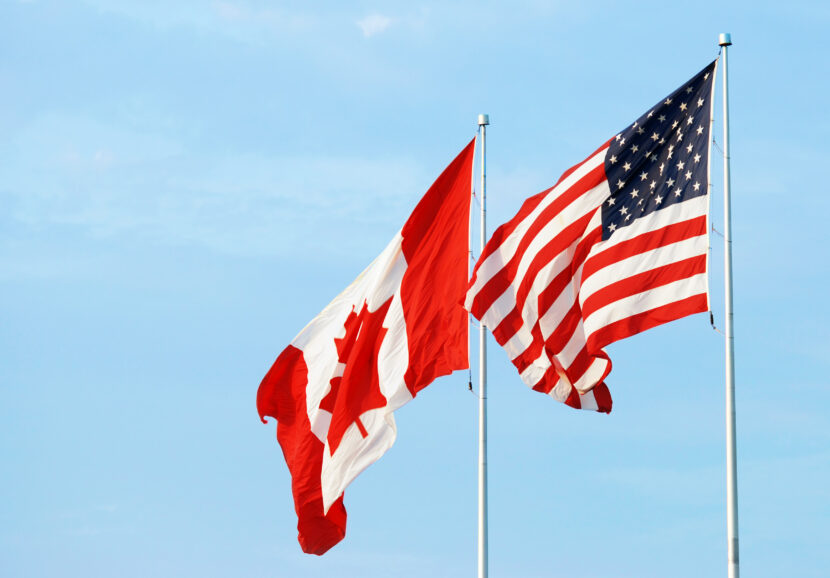
TORONTO — The road back to the U.S. may be longer than many expected.
More than two years after Canadian travel to the United States began sliding, the downturn is showing few signs of a full reversal. The trade war between the two countries escalated this week, with President Trump threatening new 50% tariffs on Canadian vehicles, auto parts and steel after Prime Minister Carney walked away from trade negotiations late Friday. Carney, who said Trump’s demands are an attempt to “destroy our major industries,” is expected to announce retaliatory tariffs against the United States today, Aug. 25.
That prolonged strain in Canada-U.S. relations has continued to shape travel patterns, with many Canadians opting for Europe and other international destinations over the U.S. as a gesture of solidarity.
According to Signal49’S latest Industry Lens – Air Transportation report, the number of Canadians returning by air from the U.S. declined year over year for 32 consecutive months through April 2026. The U.S. accounted for an average of 35.5% of Canadians returning by air from abroad, well below the 10-year average of 42.5%.
For Robin Wiebe, Lead Economist at Signal49 Research, the shift appears likely to last for some time.
“Canadians certainly seem upset with the U.S. now, and many apparently vow never again to buy their products, including their tourism offerings,” Wiebe tells Travelweek. “This seems likely to persist for at least a couple years.”
WHAT’S DRIVING THE HESITATION?
Wiebe believes the biggest obstacle isn’t airfare or marketing – it’s the broader relationship between the two countries.
Asked what would be required for Canadians to return to the U.S. en masse, he points first to politics.
“New leadership and new policies would be the most important factors,” he says, adding that marketing campaigns, incentives and restored airlift could help, but would play “a supportive role.”
His outlook also suggests the current shift is significant, but not necessarily permanent.
“’Permanently’ is a long time,” Wiebe says. “Presidential changes could eventually soften Canadians’ attitudes.”
CAN PROMOTIONS TURN THE TIDE?
U.S. destinations haven’t been standing still.
Over the past two years, several states and cities have launched promotions specifically targeting Canadians, offering discounts, special packages and campaigns designed to encourage visitors to return.
But Wiebe says the results have been modest.
“We’re seeing limited success,” he says, pointing to recent reporting and Statistics Canada data that show the magnitude of the decline since 2024, along with only a gradual recovery.
In other words, discounts alone aren’t proving enough to overcome broader concerns affecting travellers’ decisions.
RECOVERY WON’T HAPPEN OVERNIGHT
If Canadians do return to the U.S. in larger numbers, the pace of recovery will depend on more than just politics.
Economic conditions remain an important piece of the equation.
Signal49’s report notes that overall travel demand continues to face headwinds from a sluggish Canadian economy, stagnant employment and weaker consumer confidence, even as travellers become somewhat less concerned about global uncertainty.
Seventy per cent of survey respondents still planned to take a leisure trip this summer, and the share planning international travel increased to 29%, up from 25% a year earlier.
Wiebe says those economic factors will heavily influence how quickly U.S. travel rebounds.
“A soft economy with weak employment could impair travel to all destinations, including the U.S.,” he says. “A new president featuring similar attitudes toward Canada as the present one would also be a travel obstacle. U.S-bound travel would recover slowly in these instances.”
On the other hand, “a solid economy and a Canada-friendly president could foster a relatively rapid rebound in trips to the U.S.” he adds.
