





TORONTO — Since gas prices started climbing in March, Sarah Bradley has found herself bargain hunting across multiple grocery stores in Montreal.
“Before, I’m a one-stop shop person,” she said. “Now I think twice. I’m like, OK, do I need that from IGA or can I find it somewhere else for cheaper?
“It’s insane,” she said of the cost of filling up her Toyota RAV4 SUV this week, an expense that eats into other parts of her budget.
In fact, Bradley’s not even filling the tank. She’s pumping 12 litres for $24.57 at a Petro-Canada station where the price just breached $2 a litre. The rest she planned to pump at a Costco, where she’s a member and gets a discount.
“I’m on the road a lot and it affects our lifestyle choices, absolutely,” the consultant said.
As the conflict in the Middle East drags on and the global oil supply dwindles, the price of gas continues to hover near historic highs, with no sign of dropping before the travel-heavy summer season kicks off in earnest – or even before it winds down.
According to Natural Resources Canada, regular unleaded gasoline cost $1.98 per litre on average across the country on Thursday, climbing over the past week as it traced oil price trajectories.
Gas prices reached $1.94 per litre in Toronto, $2.04 in Montreal, $2.23 in Vancouver, $1.90 in Calgary and $1.92 in Halifax.
“We’re in uncharted territory. We’ve never seen an energy crisis like this,” said Dan McTeague, president of advocacy group Canadians for Affordable Energy.
“This problem of a shortage is going to stay with us for the balance of the year.”
Even if the Strait of Hormuz – normally a conduit for a fifth of the world’s oil products – opens up after a prolonged shutdown sparked by the U.S.-Israel attack on Iran on Feb. 28, it will take months or even years before Persian Gulf producers can start churning out petroleum at full capacity and shipping it to refineries for wholesale purchase and retail consumption.
“The damage is done,” McTeague said, noting strikes against oilfields, refineries and natural gas facilities in Saudi Arabia, Qatar, the United Arab Emirates, Kuwait and Iraq.
“We’ve depleted all of the reserve stocks around the world,” he said. “It takes time to refill.”
More than 80 per cent of the oil and natural gas that normally passes through the Strait of Hormuz goes to Asian markets. But petroleum-based commodities are priced globally, meaning buyers all over the world feel the pinch to varying degrees.
Many crude distillation sites have slashed production, sending prices surging. And even after hostilities end, repairs at facilities damaged in attacks could take months. At some sites, replacement parts could take years to be delivered. And skepticism among shippers about genuinely safe passage through the waterway could deter traffic from returning to pre-war levels for some time.
Where the price of gas ends up this summer is “completely contingent” on whether it remains blocked, said Patrick De Haan, head of petroleum analysis at price-tracking site GasBuddy.com.
“The longer we stay there, the more Canadians may restrain their travel,” he said of high gas prices.
“For now, I’m not expecting massive drops in demand,” De Haan qualified. “A lot of Canadians, like Americans, don’t necessarily want to forego their summer travel plans just because prices are elevated.”
Instead, they might try to cut costs elsewhere, he said.
Almoustapha Haidala is one Canadian who’s had to do just that, trimming his family’s weekly grocery budget.
“We’ll definitely cut back on food. Cutting back on food will affect our quality of life,” said the Montreal security guard in French as he filled up his Toyota Corolla while glancing up at the pylon sign reading $2.01 per litre.
“It’s too high. And it makes our expenses climb at the end of the month, which means we’re really struggling financially with everyday life.”
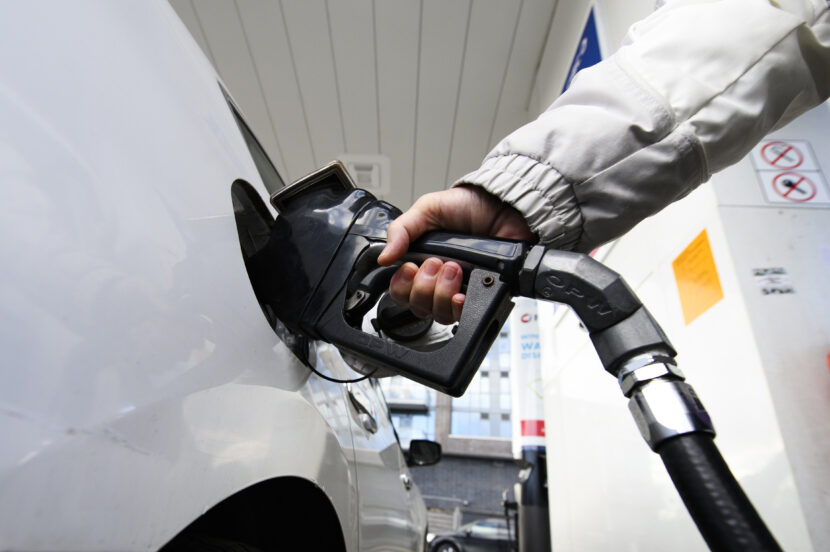
Lead image caption: A woman pumps gas at a gas station in Mississauga, Ont., Feb. 13, 2024 — CREDIT The Canadian Press/Christopher Katsarov