


MONTREAL — Intense competition curtailed Transat’s ability to shift the swelling cost of fuel onto passengers’ shoulders, Transat CEO Annick Guérard told analysts on a conference call in September.
“There were big (capacity) increases on the Atlantic market,” said Guérard.
“When we introduced fuel surcharges, the demand went down. The whole Canadian market — competitors, everybody — started to launch promotions. And it never ended.”
Those deals and discounts prevented Transat from raising ticket prices and forced it to tamp down some fees. “We’ve never seen such a highly competitive network,” Guérard said at the time.
As reported yesterday, pricier jet kerosene added some $105 million in expenses in Transat’s three months ended Oct. 31 versus the same period a year earlier. That brings fuel costs from the war to nearly $280 million so far this year, a toll that amounts to nearly half of Transat’s fuel expense for all of last year. Transat said it has retained financial advisers to assist in evaluating all potential financing and other corporate opportunities.
The company secured $250 million in federal aid from the Canada Enterprise Emergency Funding Corp. in September. The low-interest line of credit came on top of a $150-million government loan in July.
“The corporation continues to manage its day-to-day business rigorously. However, its ability to pass higher fuel costs on to customers has remained so far limited which puts ongoing pressure on its financial position,” Transat said.
FURTHER CAPACITY RATIONALIZATION
“We would caution against assuming that Transat’s financial challenges will necessarily translate into a meaningful reduction in competition, given the Canadian government’s historical willingness to support smaller airlines,” said analyst Savanthi Syth of Raymond James.
“Ultimately, we view further Transat capacity rationalization — not an acquisition or exit — as the more plausible source of upside for Air Canada, although the magnitude and timing remain uncertain,” she said in a note to investors.
As for the possibility of a merger, “history suggests significant hurdles,” Syth added.
Air Canada had been on track to buy the company after reaching a deal in 2019, but COVID-19 and then European red tape tripped up that plan.
An earlier $720-million purchase price was watered down to $190 million in October 2020 as the pandemic devastated the airline industry. The federal government greenlit the transaction in early 2021, but the European Commission raised competition concerns over transatlantic routes, prompting the parties to call off the agreement.
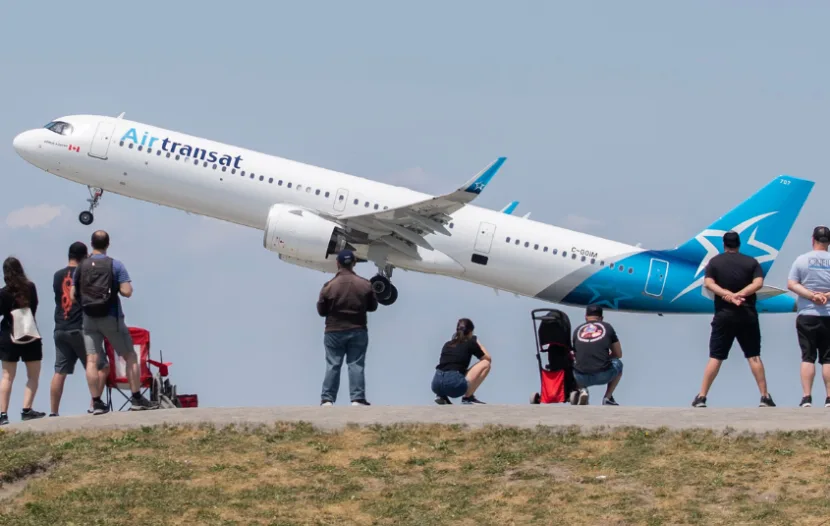
Lead image caption: An Air Transat plane takes off in Montreal, June 11, 2023 (THE CANADIAN PRESS/Graham Hughes)