


TORONTO — The ‘never a dull moment’ mood in the travel industry these days hit new heights this weekend after the FAA’s Nov. 13 ground stop led to more than 18,500 flight cancellations and thousands more delays.
Just about every airline with flights within the U.S. or in or out of the U.S. was impacted, as well as airlines with flights flying over U.S. airspace. The Globe and Mail reported that Air Canada cancelled some 250 flights on Friday, impacting 27,000 passengers.
U.S., Canadian and international carriers cancelled additional flights on Saturday and Sunday. Questions now arise about airlines and passenger compensation. “We all understand that whatever happened on Friday was outside of carriers’ control, but I have heard about passengers who were told that their flight from St. John’s to Toronto was cancelled somehow, allegedly because of the U.S. situation, and you know that’s sheer nonsense,” Gabor Lukacs, airline passenger rights advocate, told the Globe.
According to Reuters, the cost from the 4.5 hour ground stop and its knock-on effects over the weekend could top US$345 million for the U.S.’s four largest airlines: American, Delta, United and Southwest.
As reported Saturday, U.S. Transportation Secretary Sean Duffy warned that without more funding, U.S. air traffic control infrastructure is going to continue to fail. Reuters said on Saturday the shutdown may have originated with a single router installed by a U.S. government contractor.
COULDN’T HAVE COME AT A WORSE TIME
Canadian travel advisors were once again on the front lines.
“We had multiple passengers affected. Those that were close by, such as New York and Boston, we made alternative travel plans on the train,” said Robert Townshend, President, Total Advantage Travel & Tours in Toronto.
He said he had other clients who booked a private driver to come back. Ultimately, “we managed to get everyone rebooked and home.”
It couldn’t have come at worse time of the week, he added. “If the FAA needed a few hours’ break, the worst time would be on a Friday afternoon.”
Townshend said several advisors at his agency came in on Saturday to ensure all clients got home safely. “It was another example of travel agents working harder and longer without any additional pay” he said. “I’m sure the airline employees that worked extra hours on Friday and Saturday didn’t do it for free. We always end up working for free!”
“THEY SHOULD LOOK NORTH”
Aviation management expert John Gradek says Canada is less likely than the U.S. to ground flights nationwide as that country did on Friday afternoon, calling the Canadian system a model its southern neighbours should look to.
Gradek says the Canadian system is more robust and modernized than the one the U.S. Federal Aviation Administration operates with.
“They should look north — they should look to Canada,” Gradek said.
“You have to take it out of the hands of the politicians to finance your air traffic control system … If the system can go down the way it did Friday night because some guy supposedly clipped a wire on a router … and it brings down the whole of the U.S. aviation system, something is wrong.”
The FAA issued a so-called ground stop order on Friday, citing communications issues affecting the nearly two-dozen air traffic control centres that direct planes en route between airports across the country.
Airports across Canada suspended flights to and from the U.S., and Air Canada said late Friday that it was cancelling the rest of those flights for the rest of the day.
The U.S. order was lifted late Friday and flights resumed, but airlines warned it could take days before things are back to normal.
The FAA on Sunday described a radar site in Amarillo, TX and a radio communications site in El Dorado, AR, as potential sources for the problem, which involved excess data flooding the air-traffic control system and causing intermittent disruptions to communications and radar feeds.
U.S. Transportation Secretary Sean Duffy said after a contractor replaced old copper wire with new fibre wire at the Arkansas site and the router was turned on, a problem then cropped up in Texas, cascading into the ground stop.
In multiple appearances on Sunday news shows, Duffy continued to press Congress for billions of dollars for upgrades to the air-traffic control infrastructure.
“I can’t apologize for what was passed on to us. And I can’t blame Republicans or Democrats, because it’s all of them. It goes back, 20, 25, 30 years of a lack of investment,” he told NBC’s Meet the Press.
Gradek said the funding model of the American FAA is entirely the problem, and that the agency is operating with outdated equipment instead of modern fibre optic cables that can handle higher surges of data.
In Canada, air navigation service provider NAV Canada operates outside of government, collecting its funding from airline ticket sales, which Gradek said shields the non-profit organization from political decisions about how much resources should be allocated to it.
“We’re the envy of the world in Canada in terms of how we have our air-traffic control systems in place, and the management of those systems by NAV Canada,” Gradek said.
“I’ve never seen this type of fragility in an air-traffic control system where one wire brings down everybody.”
NAV Canada said its systems were not affected by Friday’s outage in the United States, and air-traffic services in Canadian airspace continue to operate normally.
The statement pointed to $3.5 billion it invested in the air-traffic management system and associated infrastructure.
“Redundancy is built in at multiple levels, including backup systems and established contingency procedures that our teams train on regularly so that operations can continue safely,” spokesperson Maryam Amini said.
With file from The Canadian Press
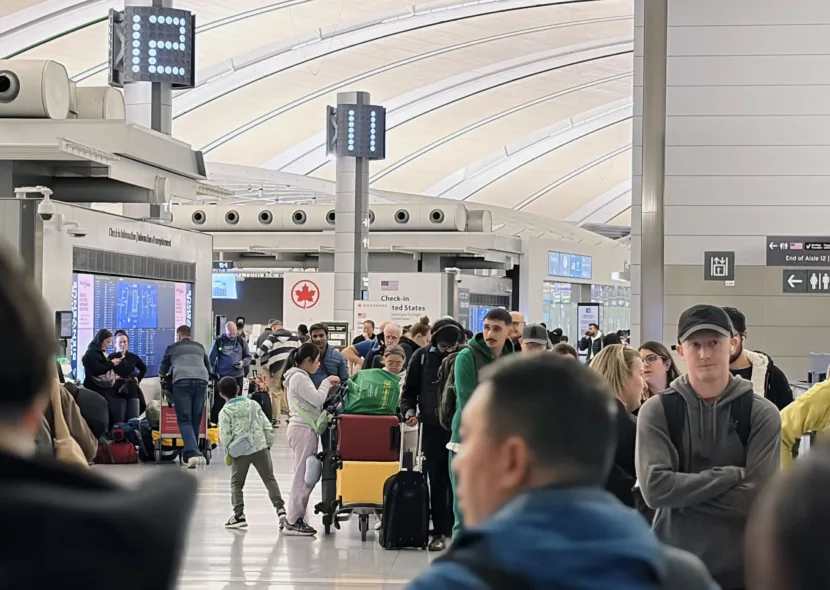
Lead image caption: People wait in line to rebook cancelled flights at Pearson International Airport in Toronto on Nov. 13, 2026 (THE CANADIAN PRESS/Sandra Ezekwesili)
