


TORONTO — Officials across Europe reported another round of bomb threats against commercial flights on Friday, continuing a string of hoaxes that have forced diversions and disrupted air travel this week.
No explosives have been found and no injuries reported, but the threats have heightened concerns amid other recent disruptions across Europe, including attacks on supermarket refrigeration systems and drone incursions.
French Prime Minister Sébastien Lecornu’s office said four aircraft flying over French territory received bomb threats Friday. All landed safely and bomb disposal teams were conducting inspections.
A Tarom flight from Prague to Bucharest also received a threat but landed as scheduled. Airport officials later confirmed it was a hoax.
In Portugal, police investigated a threat against a Ryanair flight from Lisbon to Rome. The aircraft was inspected in Lisbon, with passengers and luggage undergoing additional screening before departure.
A Wizz Air flight from Prague to Rome was diverted to Venice following a bomb alert. Passengers were evacuated and security checks found nothing suspicious. Airport operations were briefly suspended before resuming.
Authorities in Denmark and the Czech Republic also investigated threats Friday. Copenhagen police responded to threats involving air traffic for a second consecutive day but said passengers were never in danger and airport operations continued normally.
Czech police reported threats involving nine flights arriving from Denmark, Spain and Britain or departing for the Netherlands, Cyprus, Romania, Italy and Britain. Authorities said security measures had minimal impact on airport operations.
WHO’S BEHIND THE THREATS
More than two dozen flights were targeted earlier in the week, with several diverted while authorities investigated. No group or state actor has been identified as responsible, and there is no evidence linking the hoaxes to any government.
An email sent Thursday to airport authorities in Rome and reviewed by The Associated Press purported to come from an anti-feminist group claiming to target a “feminist regime.”
Another European airport received a similarly worded threat, although it remains unclear whether the messages came from the same sender.
“TOTALLY UNACCEPTABLE”
Bomb threats are on pilots’ minds and create unnecessary tension, but crews are prepared to respond professionally, said Paul Reuter, VP, European Cockpit Association. Pilots review procedures with cabin crews, identify airports where they could divert and may carry extra fuel, he said.
Reuter called the use of civil aviation for geopolitical disruption or hoaxes “totally unacceptable.”
Aviation intelligence specialist Rhys Jones, in an interview with The Globe and Mail, said “low sophistication increases the number threat actors that are capable” of creating bomb threats. “You don’t need nation state backing. You don’t need lots of money.”
Former pilot Martin Drake, also speaking with the Globe, said in the case of bomb threats pilots issue a mayday alert and head to the nearest airport, with security officials taking over with searches of the aircraft, luggage and passengers once the plane has landed. Noting the time and expense involved, Drake told the Globe: “The company I worked for had a 747 diverted to Montreal, and that aircraft was on the ground for nearly 12.5 hours while the Mounties did their job of scouring it.”
Drake said he didn’t expect ramped up passenger screening at airports.
“THIS IS JUST THE BEGINNING”: GRADEK
Aviation industry expert John Gradek told Travelweek he just wrapped up an interview about the threats with European news outlet TRT World.
“I think it’s too early to determine which specific organization or country is responsible. There are a lot of rumours going around about whether it’s Russia, North Korea, Iran or China. There are many suspicions about where this is coming from,” he told TRT World.
“The only thing we can do at this point is react, and the response time has been very good. The airline industry has seen this type of hoax as part of regular operations. We are prepared, we know what to do and we know how to handle it.”
Gradek expects passenger disruption. “My concern is the extent to which this could expand beyond the 10 or 15 flights a day and potentially spread geographically to other parts of the world,” he said.
“The one thing we should be very concerned about is that this is not the end. This is just the beginning of these threats, and they are going to continue. We have to be ready for them.”
He added that an increasingly interconnected world comes with increasing risks and vulnerabilities. “We rely on the Internet, electronic communications and our cellphones to a greater degree than ever before. When our lives become dependent on electronic communications, and when there are ways to intercept or divert those communications, we are at risk.”
At the same time, he noted, reducing reliance on electronic communications carries risks of its own. “We’re caught between a rock and a hard place in terms of how we manage our lives in 2026, with all these threats going on around us.”
With file from The Associated Press
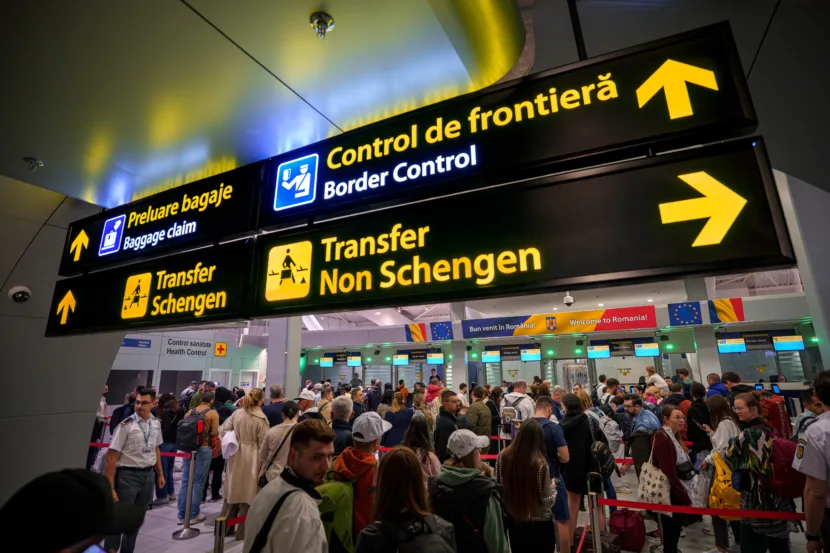
Lead image caption: Passengers arriving at the Henri Coanda International Airport in Otopeni, near Bucharest, Romania, March 31, 2024 (credit AP photo/Andreea Alexandru)
