





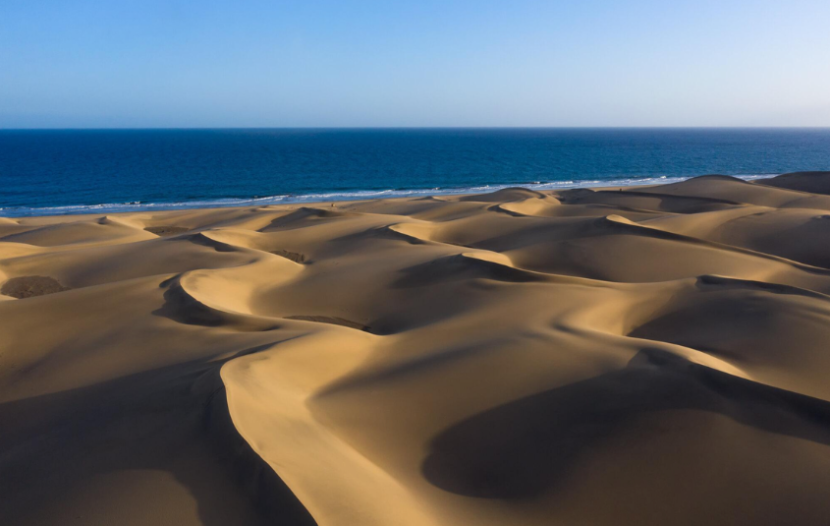
Gran Canaria is often described as a “continent in miniature,” and it only takes a single trip to understand why. On an island barely 50 kilometres from end to end, travellers can move from golden sandy beaches to pine forests, from a towering dune field by the sea to volcanic mountain landscapes, all within the same day. Few destinations anywhere in the world pack this much variety of scenery and microclimate into such a compact territory, and that is precisely the island’s best introduction for a visitor discovering it for the first time. This is not a one-postcard island, but a many-postcard one, and each of those postcards is striking enough to justify the trip on its own.
This diversity shows up most clearly in the island’s two main tourist hubs. In the south, Maspalomas concentrates most of the island’s hotel capacity around its famous dune field, a protected natural area, alongside the beaches of Playa del Inglés and Meloneras. It is a zone built for relaxation, with a long seafront promenade, lively nightlife, and countless leisure options by the water. Families, couples, and travellers of every age find their own rhythm here, whether on beachfront terraces, on one of the area’s many golf courses, or simply walking among the dunes at sunset, when the golden light turns the landscape into one of the most photographed scenes in the entire Canary archipelago.
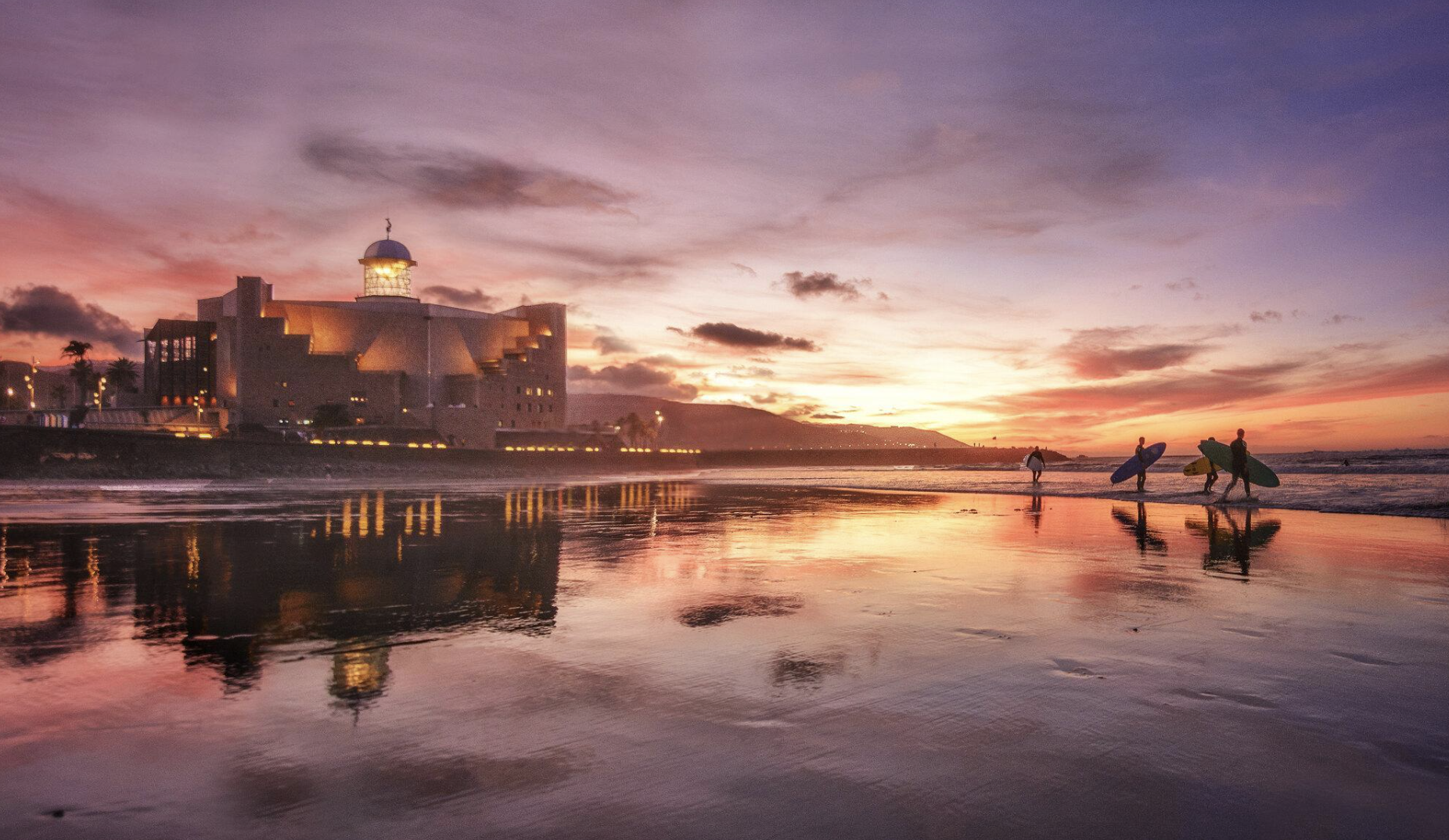
Sunset at Playa de Las Canteras, Las Palmas de Gran Canaria, with the Alfredo Kraus Auditorium
In the north, the island’s capital, Las Palmas de Gran Canaria, offers a completely different experience: a genuine Spanish city by the sea, home to Playa de Las Canteras — one of the finest urban beaches in Europe — and a historic quarter, Vegueta, dating back more than five centuries. Here, the everyday life of a provincial capital blends with the relaxed atmosphere of a coastal city and a lively cultural calendar that runs all year round, far removed from the stereotype of a purely seasonal holiday destination.
Between these two extremes, the island’s interior holds another surprise: a landscape of mountains, ravines, and pine forests covering much of central Gran Canaria, crowned by the emblematic Roque Nublo. Locals often describe the island as a place where, in less than an hour’s drive, you can go from sunbathing on the beach to feeling the cool air of high-altitude pine forest. This closeness between such different landscapes is a distinctive selling point compared with other sun-and-sand destinations, where the offering is usually limited to the coast, and it explains why many visitors who arrive thinking only of the sun end up extending their stay to explore the rest of the island.
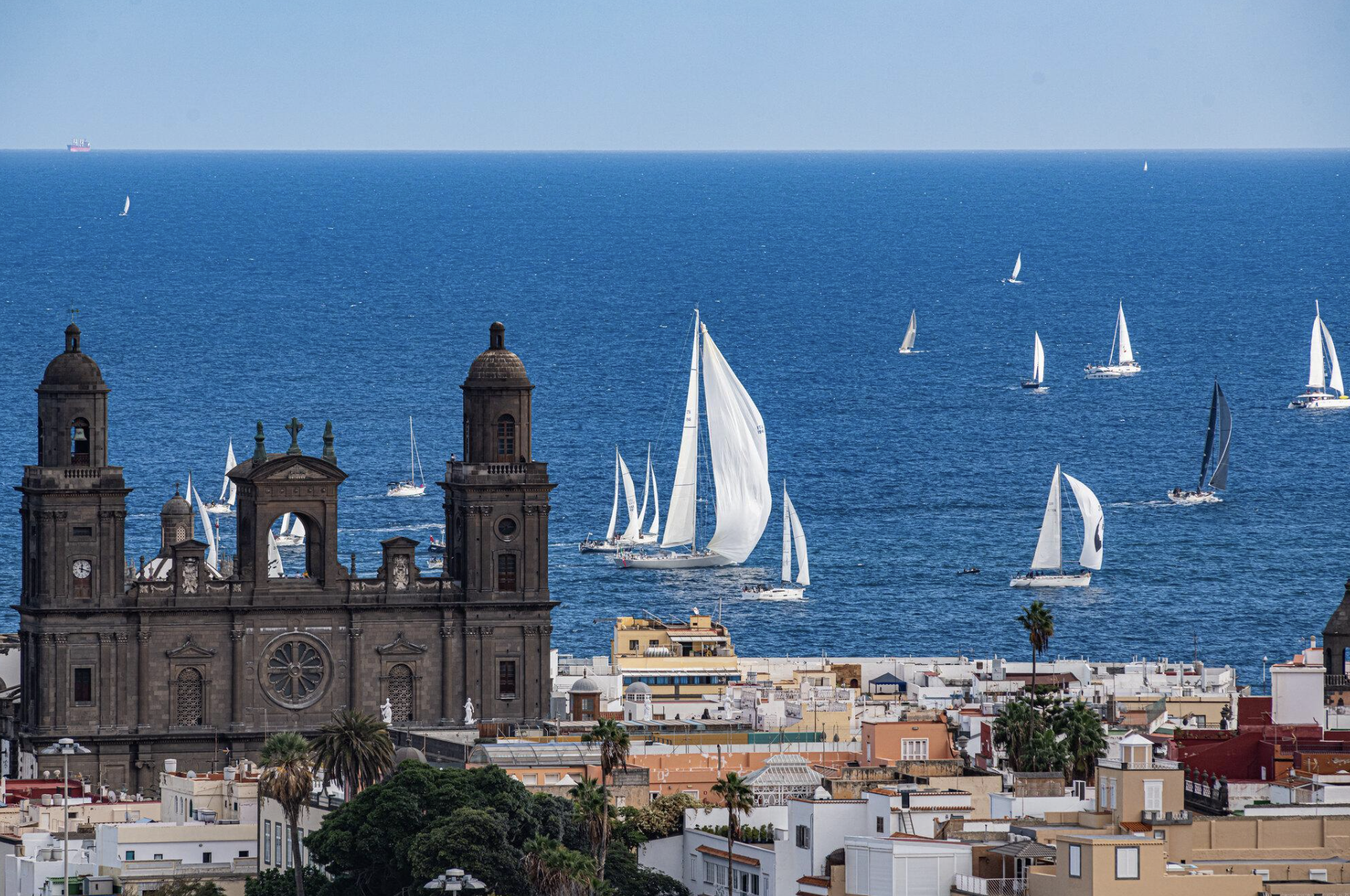
The Cathedral of Santa Ana in the historic Vegueta quarter, with sailing boats off the coast of Las Palmas
This natural diversity carries international recognition of its own: UNESCO declared Gran Canaria a Biosphere Reserve in 2005, covering 43% of the island in acknowledgment of its exceptional biodiversity and the way its rural communities balance traditional farming with conservation. That same quality extends to the dining scene: the 2026 Michelin Guide recognises five starred restaurants on Gran Canaria, where chefs reinterpret traditional Canarian cooking with modern technique and island-grown produce.
What ties all of these landscapes together is the climate. Gran Canaria enjoys an average temperature of around 20-24°C throughout the year, making it one of the few European destinations where good weather is not tied to the season. For travellers looking to escape winter without a long-haul flight from Europe, this climate stability is often the deciding factor when choosing a destination — a mild subtropical climate, tempered by the trade winds and the Atlantic, that allows a beach day, a swim, or a mountain excursion to be enjoyed in practically any month of the year.
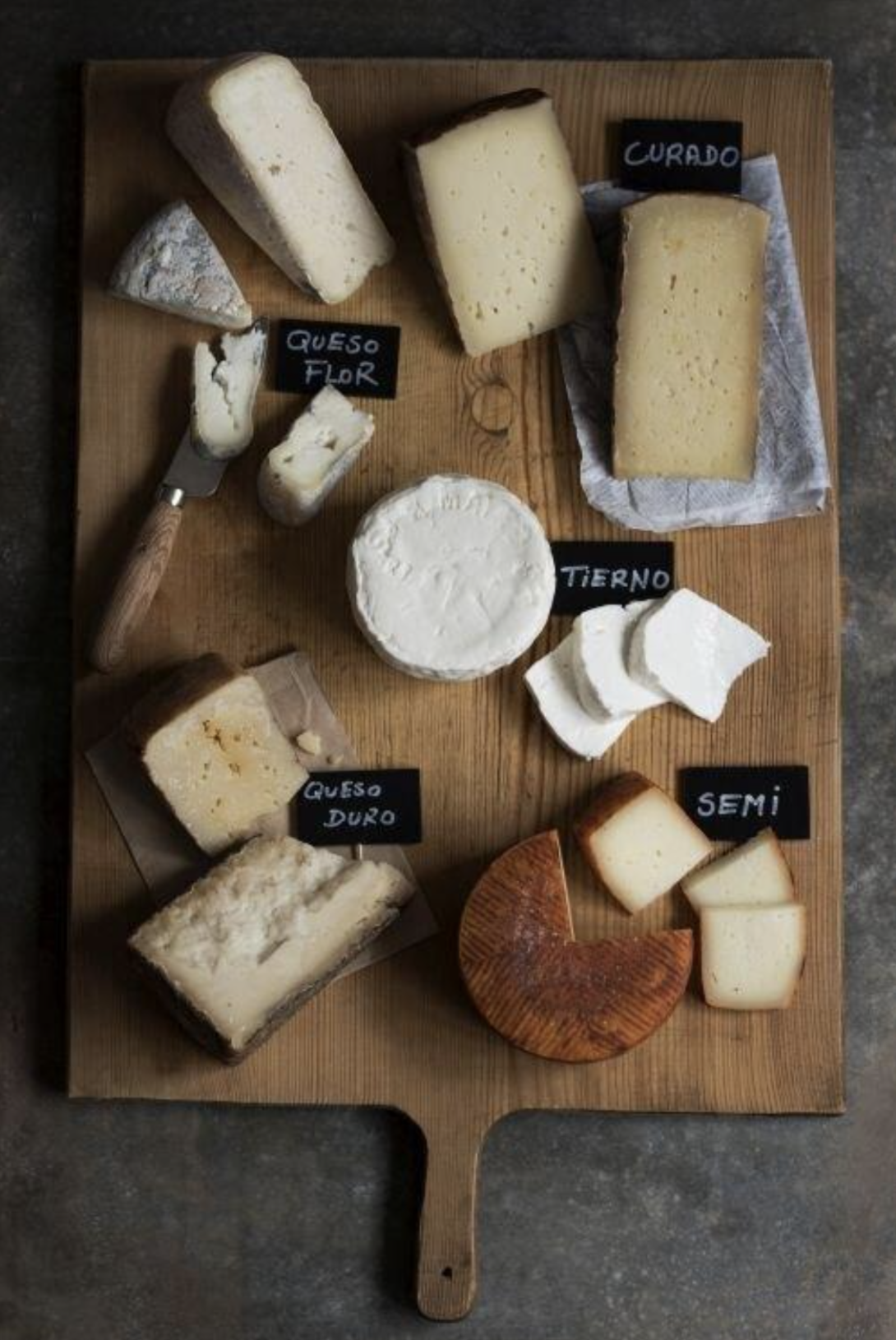
A board of Gran Canaria cheeses, from fresh to cured, including Queso de Flor
And, fittingly for an island with so much personality, Gran Canaria’s food culture reflects the same diversity. Among its products with the strongest international reputation are the island’s cheeses, which hold their own Protected Designation of Origin: Queso de Flor de Guía, Queso de Media Flor de Guía, and Queso de Guía, all produced in the north of the island and recognised by experts worldwide for their uniqueness. These cheeses, with white or yellow pastes depending on their curing, are made from sheep, cow, and goat milk, and some even use vegetable rennet obtained from thistle flower — an age-old technique that gives them an extraordinary creaminess found nowhere else in the world.
Tasting a board of Canarian cheeses is, for many visitors, their first and most memorable point of contact with the island’s food culture. This combination of high-quality local produce, backed by protected designations of origin, and a food scene that ranges from traditional recipes to Michelin-starred cuisine, adds an extra layer of interest to a destination many travellers still associate purely with sun and sand.
This is not just a matter of local pride: Canarian cheeses regularly prove their quality on the international stage. At the 2026 Cincho Cheese Awards — one of Spain’s most prestigious cheese competitions, judging 1,300 entries from 18 countries — Canarian producers took home four Gold and one Silver award, with two of those Gold-winning cheeses made right here on Gran Canaria. Those curious to go further can follow Gran Canaria’s own Cheese Route, guiding visitors to family-run dairies across the island’s interior to taste and buy cheese directly from the producers who make it.
For a first-time visitor, this is arguably the most useful way to think about Gran Canaria: not as a single type of holiday, but as several holidays layered on top of one another, each accessible within the same short drive.
Gran Canaria, then, is no one-sided destination. It is a place where beach, city, mountain, climate, and a food culture all its own come together in a compact, easy-to-explore island — a strong, differentiated proposition against other guaranteed-sun destinations, and an island that invites travellers to discover it more than once.
Learn more: grancanaria.com/turismo/en/ | Cheese Route: grancanaria.com/turismo/en/gastronomy/rutas-gastronomicas-de-gran-canaria/cheese-route/ | Biosphere Reserve: grancanaria.com/turismo/en/nature/world-biosphere-reserve/
