





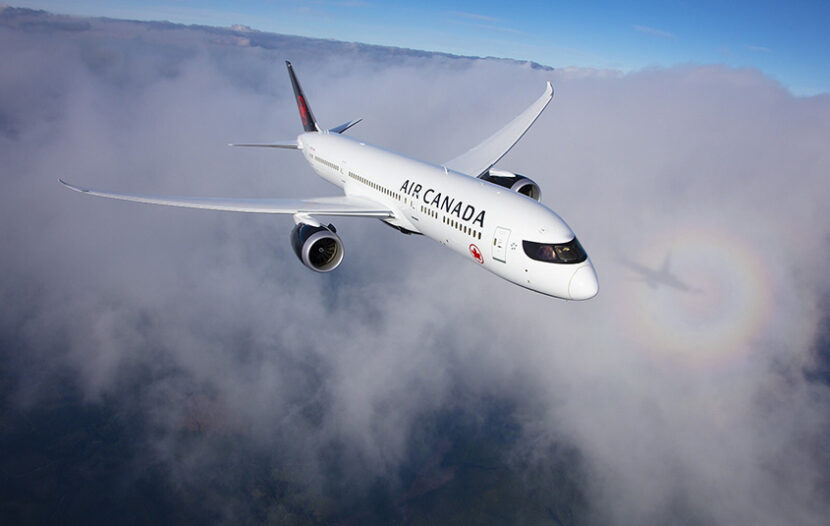
TORONTO — Air Canada delivered a “strong 2025 … and an exceptional Q4,” said President and CEO, Michael Rousseau, in the airline’s full-year and fourth-quarter earnings call this morning.
Air Canada hit record operating revenues of $5.8 billion in the fourth quarter of 2025, reaching $22.4 billion for the full year. The airline flew 45.3 million passengers last year, with a 0.8% YOY increase in capacity.
Rousseau thanked Air Canada’s team for getting through a demanding year – one that included strike action by flight attendants in August 2025 – and also praised employees for their resilience through recent record cold and snowfall across much of Canada. “Managing through severe weather effectively … is no easy feat,” said Rousseau on this morning’s call.
TRANSBORDER TRAFFIC & CUBA FLIGHTS
In a sign of the times, as Canada’s airlines have adapted to transborder travel’s new normal, questions about Air Canada’s U.S. routes weren’t front and centre like on past calls. Canada-to-U.S. travel is still down, but so far it’s plateaued. Rousseau noted that transborder traffic “has remained relatively steady from a trend perspective over the past year.”
Air Canada’s repatriation flights bringing Cuba vacationers back to Canada continue, and Rousseau said the airline expects “minimal financial impact.” Earlier this week aviation industry expert John Gradek said airlines including Air Canada, WestJet and Air Transat would be faced with redeployment questions as aircraft are suddenly pulled off high season Cuba routes.
A350-1000 DELIVERIES START IN 2030
Air Canada’s fleet will get a big boost with the A350-1000. Air Canada has ordered eight A350-1000s, as announced this week, with deliveries scheduled to start in the second half of 2030. With a range of up to 9,000 nautical miles, the A350-1000 is expected to support nonstop services from Canada to high-growth markets across the Indian subcontinent, Southeast Asia and Australia. Air Canada says the aircraft’s performance and cost efficiencies will provide a competitive advantage as it continues to expand its international network.
“What we like most about that airplane is its range capability,” as well as its ability to service existing routes even better, said Mark Galardo, Air Canada’s EVP & CCO, and President, Cargo. “We have a lot of flexibility with that aircraft. It will solidify our global ambitions into the next decade.”
Air Canada’s international network has long been key to the airline’s strategy. International performance contributed close to 90% of the airline’s revenue uplift for Q4, noted Galardo. In May 2025 Air Canada announced a 16% increase in capacity to Latin America for this winter, as some U.S. routes took more of a backseat. Transatlantic has also done extremely well for Air Canada. Premium cabin performance is also key for the airline, with far fewer seats than economy but contributing 30% of total passenger revenue, said Galardo.
LOOKING AHEAD TO 2026
Air Canada added 13 new destinations in 2025, and will bring on seven new destinations for summer 2026, and recently announced Sapporo (from YVR) and Quito (from YYZ and YUL) for winter 2026-2027.
For 2026, Air Canada is seeing sustained velocity for bookings in Q1 and into Q2, said Galardo, with 3.5 – 5.5% YOY capacity growth expected for this year.
Air Canada is also pushing ahead with planned upgrades for the Air Canada Rouge onboard experience, “enhancing our competitiveness in the leisure market,” said Galardo.
