





MONTREAL — Air Canada CEO Michael Rousseau said the airline’s focus is on “staying flexible, making deliberate decisions, and managing the business to prioritize returns and protect cash flow and balance sheet strength,” as it withdraws its FY 2026 guidance amid the unpredictability of the Iran war and its impact on the price of oil and jet fuel costs and supply.
The airline’s Q2 guidance reflects an expectation to offset 50-60% of the estimated incremental fuel expense through commercial and cost actions, Rousseau said. Air Canada now expects adjusted earnings before deductions for the second quarter to come in between $575 million and $725 million.
“Despite fuel-driven fare increases, we continue to see strong demand across the network and throughout the booking curve,” he said.
Air Canada’s Q1 2026 results, announced yesterday, included operating revenues of $5.8 billion, up 11% YOY. Operating income came in at $117 million, and there was a record Q1 adjusted EBITDA of $623 million. Net income was $48 million in Q1, compared with a net loss of $102 million during the same period last year
Demand remains solid and resilient amid elevated geopolitical instability, said Rousseau.
During the earnings call Rousseau noted that the situation in the Middle East and rising jet fuel prices have created an external shock for the entire industry.
“The pace of that increase is testing demand resilience across commercial aviation and reinforcing the need for discipline. This is not unique to Air Canada; it is an industry-wide challenge that affects how airlines think about capacity, pricing and risk,” he said.
With tensions in the Strait of Hormuz still impacting the flow of oil shipments, the world’s airlines are implementing fuel surcharges, raising airfares and cutting capacity, while many in the industry warn of jet fuel supply shortages and possibly airline bankruptcies.
Air Canada has reduced capacity in summer and fall from Vancouver to Halifax, Quebec City and Miami, and from Toronto to St. Maarten. The airline has also suspended service between Toronto and Yellowknife at the end of August, and between Fort McMurray and Vancouver in late May. To the U.S., Air Canada is suspending its YYZ-SLC effective June 30, with an eye to resuming the route next year. Internationally, Air Canada has called off its new nonstop service to Guadalajara out of of YUL, removed its Montreal-Algiers service launch from its schedule and temporarily suspend service from Toronto and Montreal to JFK, effective June 1 through late October.
Air Canada also increased baggage fees, which was soon followed by WestJet. Many of Canada’s airlines have made capacity cuts, in line with moves made by airlines worldwide.
Mark Galardo, Air Canada’s Chief Commercial Officer, said Air Canada is “diligently managing an evolving geopolitical and macroeconomic landscape. Air Canada was one of the first airlines to implement fare increases as the crisis unfolded.”
And Air Canada remains resilient despite the turbulence for the airline industry. “We continue to see strong demand across the network and throughout the booking window for the latter half of the year. I believe Air Canada is very well positioned from a financial, fleet and network perspective. As evidenced by two consecutive record quarters, the airline is performing well and the team is consistently executing on our long‑term strategy,” said Rousseau.
With file from The Canadian Press
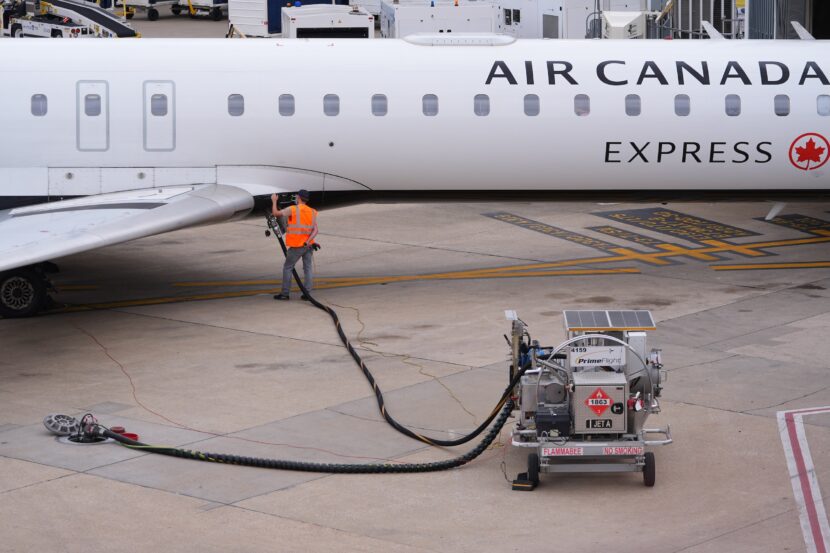
Lead image caption: A worker fuels an Air Canada jet at DFW International Airport, April 14, 2026 (AP Photo/LM Otero, File)
