





OTTAWA — The number of Canadians in Mexico who have registered with Ottawa continued to rise Tuesday, even as airlines resumed flights in and out of Puerto Vallarta and the Global Affairs Canada registration system experienced more delays.
A statement from Global Affairs Canada sent Tuesday evening said the system is slow and intermittent due to an “unprecedented” high volume of registrations.
As of 5 p.m. ET Tuesday, more than 61,000 Canadians in Mexico had registered. That had grown from about 18,000 on Sunday, to 26,305 on Monday morning, and 55,000 on Tuesday morning.
Global Affairs Canada said in peak winter months, between 100,000 and 200,000 Canadians can be in Mexico. Global Affairs Canada said the numbers provide only a general estimate of Canadians in the region, as registration is voluntary.
The department said it’s addressing a problem with the registration system, which may not provide an immediate email confirmation of the registration.
The number of registrations includes about 16,600 people in Jalisco state in Western Mexico, which is home to the popular resort destination of Puerto Vallarta.
Violence erupted in multiple parts of Mexico on Sunday, including across Jalisco, after the Mexican Army killed a drug cartel leader in a mountain town about 400 kilometres east of Puerto Vallarta by road. Gunmen blocked highways and set cars on fire in multiple places, and Canadian tourists in the region reported hearing blasts and seeing smoke and burned out buildings and vehicles.
Tourists in Puerto Vallarta were advised to shelter in place on Sunday but the situation had calmed by Tuesday. Canadian airlines also resumed flights in and out of Puerto Vallarta, Mexico, on Tuesday after widespread violence led them to temporarily suspend service on the weekend.
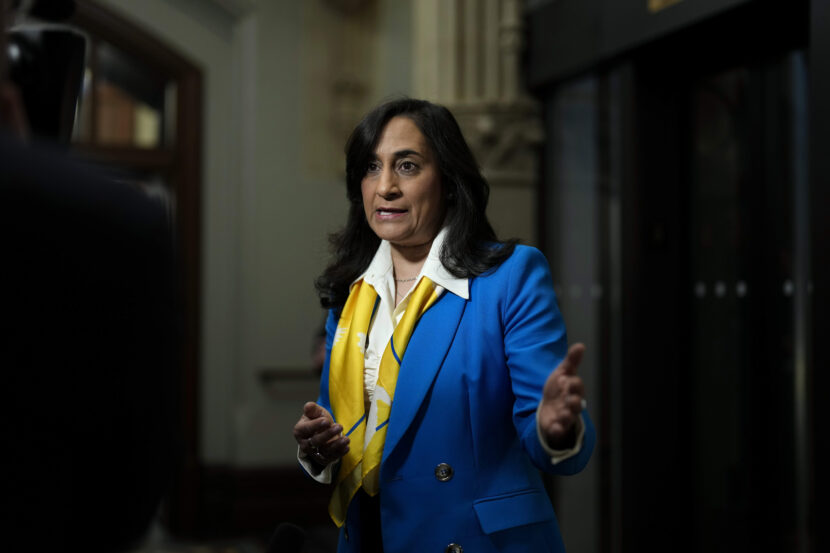
Foreign Affairs Minister Anita Anand would not say whether Canadians should reconsider plans to travel to Mexico. Instead she said those decisions should be made on a day-to-day basis.
“The advice that our government is providing is that this is a situation that is very volatile and it is evolving every day,” she said. “To make a decision about your plans for next week on Tuesday of the week before may be premature.”
Global Affairs Canada is advising people in affected areas to limit their movements and to travel to the airport only if they have a confirmed flight “and it is safe to do so.”
Anand said Canadians should follow the guidance of local authorities, as the situation is evolving and can differ from region to region.
“The long and the short of it is, the situation is becoming more normalized. We should continue to see this trajectory unfolding. The situation needs to be closely monitored as we are doing with our consular officials on the ground in Mexico,” she said.
Global Affairs Canada says Canadians should still avoid non-essential travel to more than a dozen Mexican states because of high levels of violence and organized crime.
Here’s what you need to know if you’re mulling changes to plans to visit the country:
Are airlines flying yet to Mexico? What about Ottawa’s travel advisory?
Various Canadian and international airlines have announced plans to resume service to the popular tourist destination of Puerto Vallarta and other affected areas after previously cancelling or diverting those flights.
Air Canada has said it would resume flights from Montreal, Toronto and Vancouver to Puerto Vallarta on Tuesday, with flights from Toronto to Guadalajara resuming Wednesday. WestJet said its planes will fly to and from Puerto Vallarta, Guadalajara and Manzanillo on Tuesday, following a review of current conditions. Air Transat said it would do the same on Tuesday for Puerto Vallarta, after a positive update from local authorities.
Porter Airlines also announced it would resume service to Puerto Vallarta on Tuesday, with complimentary changes through Wednesday. Flair Airlines said in a statement it plans to restore service to Puerto Vallarta and Guadalajara starting Wednesday.
As of Tuesday, however, a regional travel advisory remained in effect for parts of Mexico. Ottawa is recommending Canadian travellers avoid non-essential travel to parts of more than a dozen states due to high levels of violence and organized crime — with exceptions for specific areas within those states. No new significant security incidents were reported in affected areas on Monday, but Ottawa warned further incidents are possible.
The Canadian government’s travel advice for the majority of Jalisco, where Puerto Vallarta is located, is to exercise a high degree of caution, which is considered a lower advisory level.
Should I register with Global Affairs Canada?
Ottawa encourages citizens who are travelling to register as a Canadian abroad, for free, so the government can notify them of potential emergencies at their destination and communicate important information amid a natural disaster or civil unrest.
Travellers do not need to register to receive consular services.
Beyond that, however, don’t expect too much to come of the service, said travel expert Barry Choi.
“It really doesn’t do a whole lot. It just lets the government know that you’re there,” he said.
“If you registered thinking someone’s going to come to your hotel and deliver groceries to your door because the grocery stores are burned up, that’s not happening. Or if you were thinking that they’re going to extract you personally — not going to happen.”
Will I be refunded if I choose to cancel? What does my insurance cover?
With airlines resuming service to Puerto Vallarta and surrounding areas, insurance experts say it’s unlikely to recoup what you already spent if you decide to stay home — unless the situation on the ground worsens.
“If they’re flying, they’re not going to give you your money back,” said Martin Firestone, president of Toronto-based insurance firm Travel Secure Inc.
When it comes to insurance, he said the key question is whether travellers purchased trip cancellation and interruption coverage prior to Sunday, when Ottawa put in place a travel advisory. If so, and you planned to visit areas still under the government’s warning to avoid non-essential travel, “you have every reason to believe that the insurer should pay the claim,” said Firestone.
But for areas like Cancun and Mexico City, subject to the government’s lesser warning to exercise a high degree of caution, you likely can’t expect to get your money back if you cancel.
“For Canadians who are planning on travelling even to places like Puerto Vallarta for March break, and even if they had bought a cancellation policy prior to us knowing about the issues, most policies are not going to provide you the ability just to cancel because you’re not feeling comfortable going down,” said Travel Health Insurance Association of Canada spokesman Will McAleer.
“You’d need one of the covered risks to be there.”
What if I booked after the advisory went into place?
At this point, the violence in parts of Mexico that erupted Sunday — after the death of a notorious cartel leader as part of a Mexican government operation — is considered a “known condition.”
That means it’s too late to purchase an insurance plan with cancellation and interruption coverage which would apply to this situation, even in the regions under the higher advisory level.
“So you couldn’t necessarily buy it with that in mind,” said McAleer.
“However, if you’ve already bought it and you’ve got your trip plans, keep watching the advisory that the Canadian government is putting out, call your tour operator to determine whether or not you’ve got options to maybe rebook somewhere else or at a different time if you’re feeling concerned about that.”
Firestone said if you haven’t yet pulled the trigger on a trip down to Mexico and you’re feeling uneasy, it might be best to delay the trip.
“If you haven’t bought yet and you’re questioning it, then maybe your decision is not to go,” he said.
Lead image caption: Minister of Foreign Affairs Anita Anand arrives for a meeting of the federal cabinet in Ottawa, Feb. 24, 2026 — Credit The Canadian Press/Justin Tang