





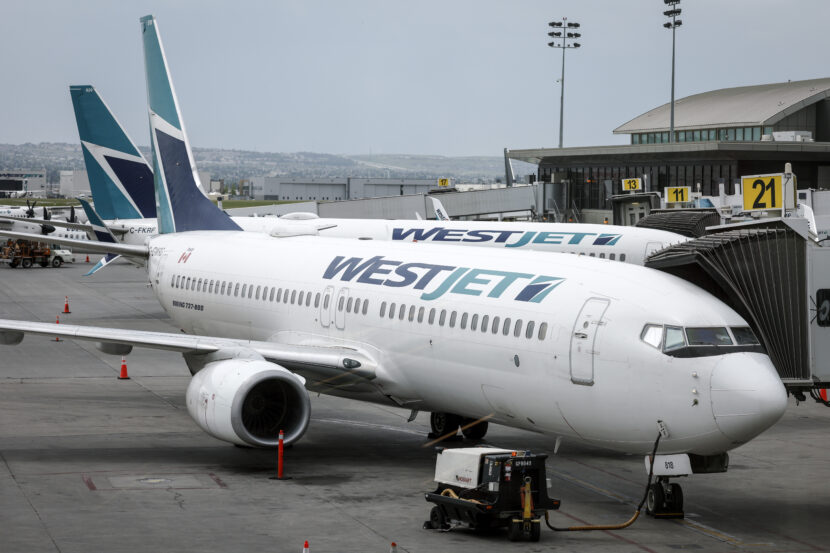
CALGARY — WestJet says it will change its cabin-configuration approach on the limited portion of its fleet where it densified seating.
The news comes after widespread coverage in consumer and trade media of a social media video showing bewildered WestJet passengers attempting to get comfortable in 28” pitch seating.
A TikTok post by an Alberta woman that has racked up more than 1.1 million views shows her parents squeezing into a row that leaves barely enough room to move their legs. “Impossible to straighten out my knees to the front,” says her father in the Dec. 27 post. “I’m going to be sharing my leg space with him,” adds her mother.
Travel advisors shared their feedback with Travelweek, with one travel advisor saying clients were requesting alternatives to WestJet based on the widely-shared TikTok video. “Some are choosing other airlines because they still offer more reasonable seating and better service. This shift towards squeezing passengers is hurting confidence,” Marianne Vogel, owner of Just for You Travel & Consulting in Dundas, ON, told Travelweek.
“FOUNDED AS AN AIRLINE CENTRED ON GUESTS”
As reported this past Friday, WestJet said that following a review of operational data and feedback from guests and WestJetters, the airline will return to its prior standard seat pitch for economy cabins on the recently reconfigured aircraft by removing one row of seats.
“WestJet tried seat pitches that are popular with many airlines around the globe as they serve to provide affordable airfares,” said Alexis von Hoensbroech, WestJet Group CEO. “As an entrepreneurial airline founded on making air travel affordable to Canadians it’s in our DNA to try new products. At the same time, it is just as important to react quickly if they don’t meet the needs of our guests.”
Von Hoensbroech and other WestJet execs had tested out the 28” pitch seats themselves amid concerns from WestJet employee unions.
WestJet had paused reconfiguration plans in December and planned to finalize its evaluation of the new interior layout mid-February; however, the airline has now accelerated the review to address feedback and provide clarity sooner.
The move reflects the airline’s commitment to align product decisions with the needs of the guest, while continuing to invest in reliability, affordability, and a modern onboard experience.
“WestJet was founded as an airline centred on guests,” added von Hoensbroech. “It is in this spirit that we will take what we’ve learned and continue to be cost-disciplined and innovative, while staying true to what our guests and our people expect from us.”
“It’s also important to recognize our WestJetters who showed up for guests with care and professionalism throughout,” said von Hoensbroech.
He noted that aircraft interiors are managed to the highest safety and engineering rigour, with changes requiring multiple phases, starting with an engineering certificate. Once this certificate is received, WestJet can begin to convert all 180-seat aircraft to 174-seat layouts, with timelines for completion still being determined.
Von Hoensbroech added that WestJet is still evaluating other aspects of the new layout, while broader cabin reconfiguration investments, including refreshed interiors, enhanced amenities and modernized design, will continue as part of the airline’s commitment to improving the guest experience.
“IT JUST DIDN’T LAND”
In an interview with newswire service The Canadian Press, von Hoensbroech said he made the final call when the blowback began to show up in the sales figures. “We saw that this was all trending in the wrong direction,” he said of data on customer loyalty and guest satisfaction. “It just didn’t land the way we were anticipating … and that’s why we’re correcting it.”
The overhaul will likely be completed by year’s end, he said.
Already installed on nearly two-dozen of WestJet’s Boeing 737s, the non-reclining seats in a majority of the cabin’s economy section featured the smallest amount of leg room on any large Canadian carrier.
The configuration had been planned for at least 20 more aircraft.
Staff and travellers warned that the cramped cabin curtails safety, particularly in the event of an evacuation, and hurts the customer experience.
WestJet has pointed out that the reconfiguration underwent a full certification process.
A dozen of the 22 rows in the planes’ economy class feature 28” pitch — the distance between one point on a seat and the same point on the seat in front — versus 29” or 30” pitches on most other carriers’ lower-tier seats. They also have what WestJet calls a “fixed recline design,” meaning they cannot be tilted back.
Hoensbroech noted that a 28” pitch is common among discount carriers, especially in Europe – where trips are generally shorter.
“However, we knew this is new to Canada,” he said from Calgary. “The unique thing about Canada is the very long stage length, particularly during the winter peak season where many of those flights were going south to the Caribbean.” Flights there generally range from four and a half to six hours.
WestJet said it will begin to convert all of its tight-packed 180-seat jets to a 174-seat layout after receiving regulatory certification.
The reconfiguration also carries complications for the airline. “It comes at a cost” – and not just from reinstalling the seats themselves – von Hoensbroech said. “You also need to deal with the overhead part of it, because there are oxygen masks and then there’s in-seat power that you need to rewire.”
The narrower rows had put some WestJet cabins on a par with budget carriers such as Spirit Airlines, Frontier Airlines and Wizz Air, all of which sport 28” seats.
However, the now-nixed configuration also carved out more space for 36 “extended comfort” seats with 34” pitch and 12 premium seats with 38” pitch, both of which yield bigger profit margins.
In December, WestJet paused a move to install the controversial seats on a big slice of its fleet amid earlier pushback, but also “to support our operations during the peak winter travel season,” said spokeswoman Julia Brunet in mid-December.
At the time, she said the airline planned to continue converting to the tighter configuration in the spring.
“WELCOME NEWS”: WESTJET PILOTS
Captain Jacob Astin, chair of the ALPA WestJet Master Executive Council, issued the following statement today after WestJet Airlines announced it was halting plans to reconfigure seating on some of its Boeing 737 aircraft.
“Following the stated employee concerns and widespread public backlash, the decision by WestJet Airlines to stop their fleet configuration plan that included cramped, non-reclining economy seating and return to the previous standard of seating is welcome news for our flight crews and our passengers.
“Our union’s consistent advocacy – highlighting concerns such as reduced passenger comfort and operational impacts – played a key role in amplifying pilot, crew, and guest feedback that supported this reversal.
“This reversal by our employer also demonstrates the power of a united pilot voice in protecting WestJet’s brand and service standards ahead of our upcoming contract negotiations.”
With file from The Canadian Press
