





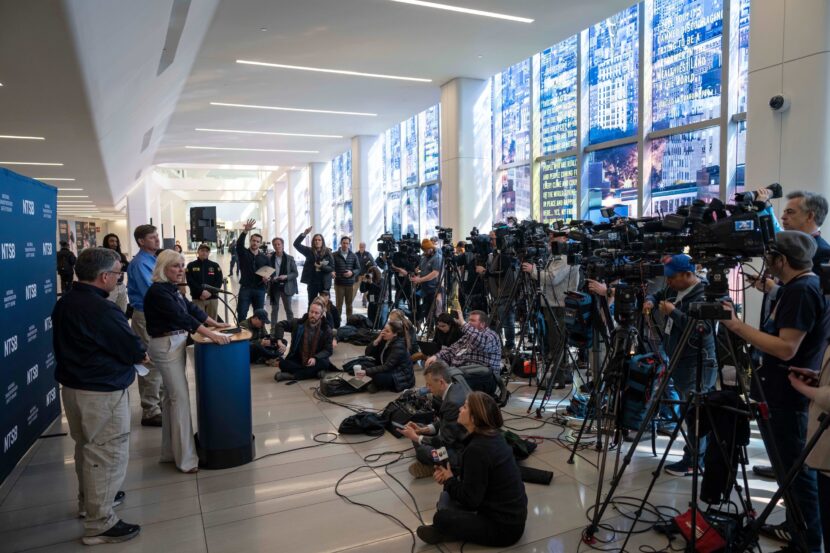
NEW YORK — One of only two air traffic controllers on duty at LaGuardia Airport cleared a fire truck to cross a runway just 12 seconds before an Air Canada flight touched down, leaving little time to avoid the collision that killed both pilots, federal investigators said Tuesday.
The National Transportation Safety Board is working to determine which of the airport’s many layers of safety precautions failed and allowed the fire truck onto the runway Sunday night.
Among the areas being explored are whether the common practice of two controllers on duty overnight is enough, why a runway warning system didn’t alert the possibility of a crash, who was coordinating air and ground traffic, and whether the fire truck heard the controller’s last-second pleas to stop.
“We rarely, if ever, investigate a major accident where it was one failure,” said Jennifer Homendy, NTSB chair. “When something goes wrong, that means many, many things went wrong.”
Several passengers were injured when the Air Canada plane, which originated in Montreal and carried more than 70 people, slammed into the fire truck. Most, though, were able to escape the mangled aircraft, and a flight attendant still strapped in her seat survived after being thrown onto the tarmac.
About 40 people, including the two from the fire truck, were taken to hospitals. Some suffered serious injuries, most were released within hours, and others walked away without needing treatment.
According to an update from Air Canada, six people remain in hospital. Air Canada’s President and CEO, Michael Rousseau, said in a video that Air Canada is fully supporting the investigative authorities in their investigation.
NTSB investigators have not yet interviewed the firefighters, who were also injured, or found whether they braked or turned to avoid the collision, Homendy said.
“FULL CO-OPERATION”: CARNEY
Prime Minister Mark Carney says Ottawa is working in “full co-operation” with officials in the United States to probe the crash of an Air Canada jet at New York’s LaGuardia Airport that killed two pilots Sunday night.
Speaking to reporters this morning, Carney said the “first job” of the federal government is to work with American colleagues to determine what caused the crash and take steps to ensure it doesn’t happen again.
The U.S. National Transportation Safety Board said Tuesday that a fire truck had been cleared to cross a runway at the airport 20 seconds before it collided with the jet.
Carney also offered his condolences to the families and friends of pilots Antoine Forest and Mackenzie Gunther and praised the men for their life-saving actions.
The airplane was carrying 72 passengers and four crew members. Six people remained in hospital as of Tuesday.
The Transportation Safety Board of Canada is also taking part in the U.S.-led investigation.
ROUSSEAU SUMMONED TO TESTIFY
Carney also said Air Canada CEO Michael Rousseau’s English-only message of condolence after Sunday’s deadly crash in New York lacked compassion.
Rousseau is being summoned to testify at the House of Commons official languages committee after he shared a four-minute condolence video online that only included two French words — “bonjour” and “merci.”
Antoine Forest, one of the two pilots killed in the crash at LaGuardia airport, was a French-speaking Quebecer.
The Office of the Commissioner of Official Languages had received 84 complaints about Rousseau’s video as of Tuesday afternoon.
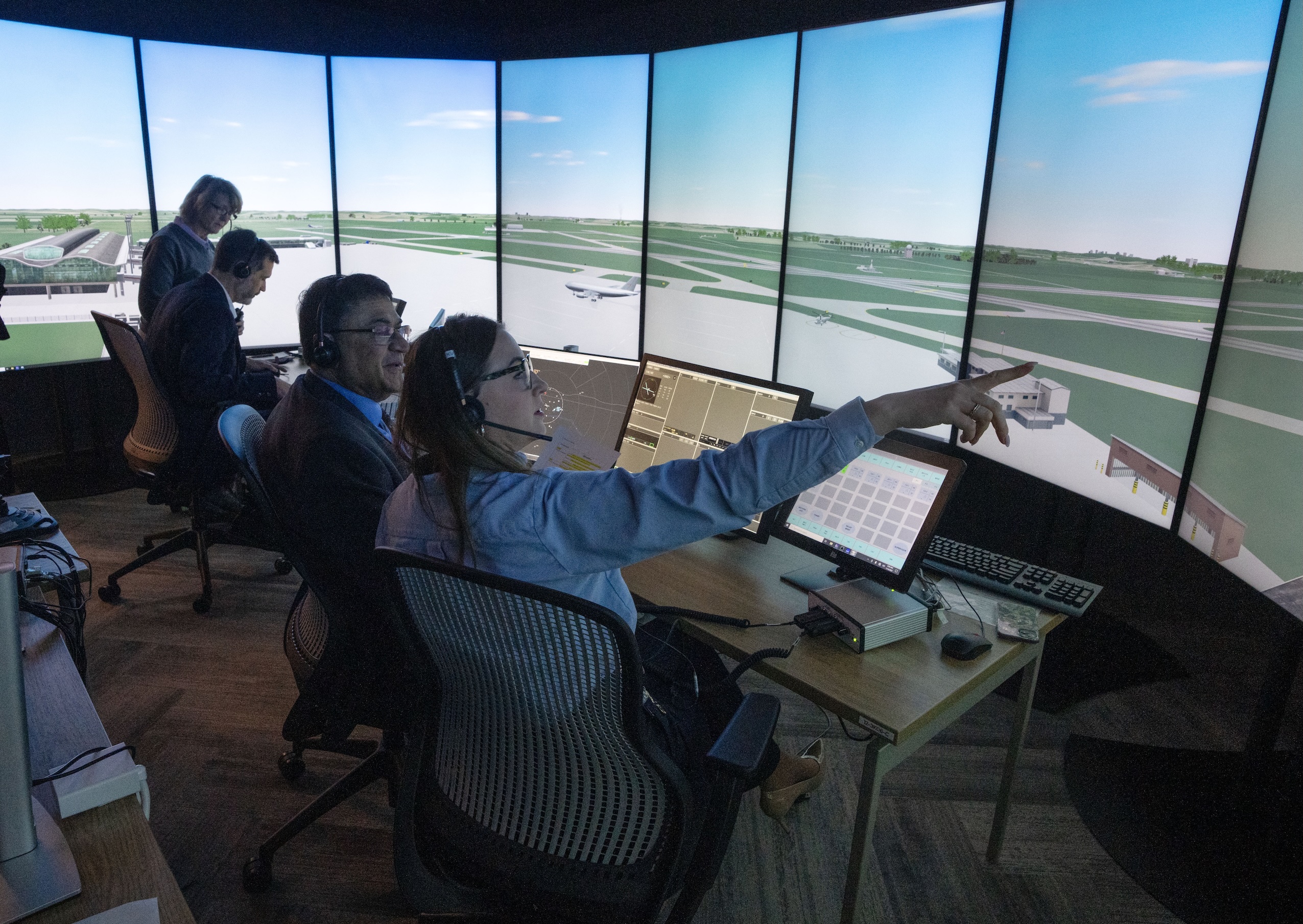
Instructor Karina Vasylenko, front, shows media how the air traffic control simulator works at the CAE training facility in Montreal, Tuesday, Jan. 14, 2025. THE CANADIAN PRESS/Ryan Remiorz
TWO CONTROLLERS ON DUTY AT TIME OF COLLISION
Investigators want to know more about the role of the air traffic controllers and what they were doing while juggling a late-night emergency involving another plane — a strong odour reported in the cabin of an outbound United Airlines jet.
Homendy warned against jumping to conclusions.
“I would caution against pointing fingers at controllers and saying distraction was involved. This is a heavy workload environment,” she said.
Having two controllers on duty in the control tower is typical for a late night shift but has long been a concern for the NTSB, she said. Both were early into the their shift when the crash happened.
The tower at LaGuardia had been busier than expected Sunday night because flight delays pushed the number of arrivals and departures after 10 p.m. to more than double what was scheduled, according to data from aviation analytics firm Cirium.
Planes were landing every few minutes, with a dozen flights arriving between 11 p.m. and when the crash happened less than 40 minutes later. At the same time, the tower was coordinating the emergency response to the unusual odour making flight attendants feel ill.
Jeff Guzzetti, an aviation safety expert who used to investigate crashes for both the NTSB and Federal Aviation Administration, said this crash may lead to questions about whether having two controllers on the overnight shift is enough at major airports.
That has been the minimum since 2018, when the FAA imposed that requirement after several instances of controllers falling asleep while working solo.
FAA encouraged airports to install transponders on vehicles
LaGuardia is one of 35 major U.S. airports with an advanced surface surveillance system to help eliminate dangerous runway incursions and prevent crashes.
Controllers in these airports have a display in the tower that’s supposed to show them the location of every plane and vehicle.
The system, known as ASDE-X, didn’t work as intended this time because the fire truck wasn’t outfitted with a transponder, Homendy said. There were also emergency vehicles behind the fire truck that stopped in time, and the close proximity of the vehicles merging kept the system from triggering an alarm, she said.
More work is needed to determine whether an alert could have prevented the crash, she said.
Just last May, the FAA urged the 35 airports that have advanced surface surveillance systems like LaGuardia’s to equip their vehicles with transponders and said federal money was available to help pay for them.
While the NTSB hasn’t recommended that vehicles on airport grounds have transponders, they should be standard equipment, Homendy said.
The crash came at a time of increasing frustration with air travel in the U.S., caused by long security lines because of the government shutdown, winter storms and rising costs.
While flights resumed Monday at LaGuardia — the New York region’s third busiest airport — the runway where the collision happened was still closed.
CANADA: LOSING MORE AIR TRAFFIC CONTROLLERS THAN IT’S HIRING
Aviation expert John Gradek, a faculty lecturer with McGill University’s aviation management program, says Canada is losing more air traffic controllers to retirement than it is hiring, despite efforts to ramp up recruitment.
Gradek said Canada is short about 1,500 air traffic controllers, and 150 more retire each year.
“So guess what? You’re not even covering off retirements,” he said, adding that air traffic controllers are highly specialized with a “special skill set.”
“We know three dimensions. The trick about controllers is they need a fourth dimension, and they have to understand the fourth dimension being time,” said Gradek.
“And so I make a decision to move an aircraft up 1,000 feet or down 1,000 feet, or turn left or turn right. I’m making that decision because I want this airplane to be in this location at this time and in the future.
“So that’s a special skill set. Not everybody has it.”
In a statement Nav Canada said it is working to address staffing through a multi-year strategy.
“Canadians and travellers can be reassured, we are in solution mode: focused on strengthening service resiliency, supporting our people, working constructively with industry partners while upholding the highest standards of safety they rightly expect,” said Nav Canada spokesperson Gabriel Bourget.
On Monday, Canadian Transport Minister Steven MacKinnon said he is working with Nav Canada to figure out solutions to the shortage of controllers.
“I’ve asked Nav Canada to continue to come up with solutions for recruitment so that we can reduce the undue reliance we have on a smaller number of air traffic controllers than we would wish to have,” MacKinnon told reporters when asked about the issue.
As for Canadians going through the rigorous training system only to take jobs abroad, MacKinnon said he wasn’t aware of that being a problem.
“I’ll take a closer look at that,” he said.
MacKinnon on Tuesday emphasized the safety of the country’s transport systems — notably in aviation — affirming they are “among the most rigorous in the world.”
“I do want to be very reassuring that we take every precautionary measure and make sure that Canada continues to perform at the highest levels of security,” he told reporters on his way into a cabinet meeting in Ottawa.
“The Americans have very high standards, and we have a very collaborative relationship with the U.S., and I know they’ll be as eager as we to find the answers.”
With file from The Canadian Press
Lead image caption: Jennifer Homendy, the NTSB chair, speaks during a press conference, March 24, 2026, at LaGuardia Airport in New York (AP Photo/Yuki Iwamura)