





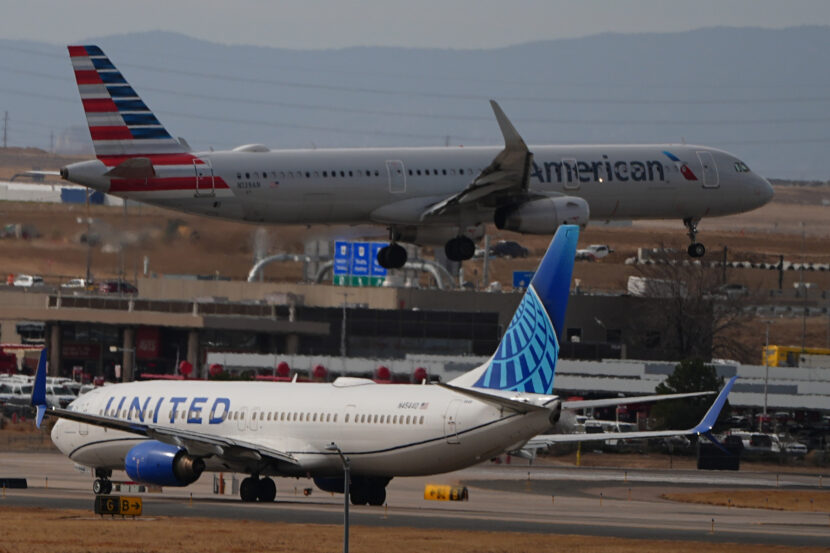
TORONTO — Major U.S. airlines say they are not expecting a significant dent in quarterly profits despite soaring jet fuel costs tied to the war in the Middle East adding hundreds of millions of dollars in expenses.
Executives from Delta Air Lines, American Airlines and United Airlines told investors Tuesday that strong ticket sales are helping offset those higher costs, with all three carriers reporting record bookings this year.
Jet fuel prices have jumped since the war began on Feb. 28 and strained global oil supplies, particularly around the Straight of Hormuz, a narrow waterway through which roughly one-fifth of the world’s oil passes. The volatile crude oil price that is driving gasoline prices higher has had the same effect on jet fuel, which is one of the airline industry’s biggest expenses, typically making up about a quarter of operating costs.
The price for a gallon of jet fuel rose to $3.93 on Tuesday, up from $2.50 the day before the war broke out, according to Argus Media. Delta CEO Ed Bastian said that amounts to roughly $400 million in additional costs so far. Executives at American and United reported similar figures while speaking Tuesday at the annual J.P. Morgan Industrials Conference.
For now, most major U.S. airlines say strong demand for air travel is helping absorb the additional costs.
“It’s across all segments, covering corporate, covering international, covering premium leisure, covering main cabin, covering our domestic system,” Bastian said. “We’re seeing strength in every market that we look at.”
Bastian noted that eight of Delta’s top 10 days for ticket sales happened this year, five of them since the start of the war.
United CEO Scott Kirby said the first 10 weeks of the year were the carrier’s top 10 weeks for ticket sales, with the past two weeks the strongest on record.
Robert Isom, American’s CEO, said eight of the carrier’s best 10 days and weeks for bookings also happened this year, and he expects high demand to continue through April and May.
The airline leaders’ comments suggest that travelers are buying now to lock in lower airfares before carriers adjust rates further as the busy summer travel season approaches.
Industry analysts say it’s not a question of if airfares will rise because of higher fuel costs, but when, for how long and by how much. The impact may be felt most on long-haul international routes, which burn significantly more fuel than shorter flights.
A number of non-U.S. carriers have already introduced fuel surcharges or raised ticket prices. U.S. airlines, meanwhile, are more likely to build those costs into base fares or adjust fees for add-ons, such as seat upgrades, because they don’t typically have fuel surcharges.
Some airlines are partially protected from sudden price spikes through fuel hedging, a strategy that locks in fuel prices months or even years in advance. But not all airlines hedge, and those that do are usually only protected for a portion of their fuel needs, meaning prolonged price surges may cause more carriers to raise fares.
If fuel prices remain elevated, airlines may also adjust schedules or reduce certain routes to limit costs.
“We’re certainly going to be nimble in terms of capacity to make sure that supply and demand stay in balance,” Isom said.
U.S. AIRPORT SHUTDOWNS POSSIBLE
Adding to the turbulence, with up to 10% of TSA workers failing to show up for work amid the U.S. government funding standoff, a TSA official said it’s possible some airports will need to temporarily shut down.
As Acting Deputy TSA Administrator Adam Stahl said this week: “As the weeks continue, if this continues, it’s not hyperbole to suggest that we may have to quite literally shut down airports – particularly smaller ones if callout rates go up.”
The CEOs of the nation’s top airline companies, including American, Delta, Southwest and JetBlue, recently implored Congress to restore funding to the Department of Homeland Security and embrace a bipartisan solution to pay federal aviation workers including airport security officers during the partial government shutdown. “Once again, air travel is the political football amid another government shutdown,” the executives wrote in an open letter to Congress.
Lead image caption: An American Airlines jetliner lands as a United Airlines plane waits for clearance to take off at Denver International Airport, March 12, 2026 — Credit AP Photo/David Zalubowski