





TORONTO — Airlines across the globe have started to hike fares and fuel surcharges in response to surging oil prices sparked by the war in Iran, and Canada is no exception.
Several carriers indicated this week that higher ticket prices are likely – or already a reality – thanks to cost pressures caused by fallout from the conflict, which entered its 12th day on Wednesday.
Air Canada spokesman Peter Fitzpatrick noted that “all airlines are subject to the current volatility” and that the price of bookings changes constantly — partly in response to those ups and downs.
Fuel often marks airlines’ biggest cost. Air Canada spent more than $5.1 billion on it in 2024, amounting to 24% of the carrier’s operating costs – its largest expense.
“The recent sharp increase due to the situation in Iran has already made operating flights more expensive. Based on this, it’s likely further pricing adjustments may be needed,” said WestJet spokeswoman Julia Kaiser.
Air Transat has already begun to tack on higher fuel surcharges for flights to Europe as jet fuel prices soar.
“What we’re also doing is currently raising fares on peak travel dates and routes where we see less competition,” Transat A.T. Inc. CEO Annick Guérard told analysts on a conference call Tuesday.
Air New Zealand, Qantas and SAS are among the large airlines to announce price hikes abroad.
The price of jet fuel skyrocketed 81% last week and on Tuesday sat 52% higher than levels from Feb. 27, the day before the U.S. and Israel launched attacks, according to figures from the Platts jet fuel index.
The global price, which rose to nearly US$4.37 per gallon last week, topped US$3.67 on Tuesday, up from about US$2.41 per gallon on Feb. 27.
The roller-coaster ride roughly traces crude oil prices, which have swelled well above recent levels during the past week and a half, currently sitting over 40% higher than before the strikes on Iran began.
Jet fuel, diesel and gasoline all derive from crude, making them sensitive to any swerve in its price. But aviation fuel has come under the greatest pressure, according to Sparta Commodities analyst June Goh. Jet kerosene tends to see the lowest inventories because it needs to be stored in specialized tanks, she said. Observers expect a major shortage in the coming weeks.
As a result, ticket prices for trips to Europe from Canada may rise by $100 to $200, and up to $400 for flights to Asia, according to John Gradek, who teaches aviation management at McGill University.
An Air Canada flight from Toronto to Frankfurt next month registers a fare of $741 — plus “carrier surcharges” of $380. Despite one obvious reason for the eye-popping add-on, it’s hard to pinpoint precisely how much of it can be attributed to fuel.
The top-up stems from cost fluctuations linked to “fuel, navigational charges, insurance charges or select peak travel dates … among others,” according to the Air Canada booking site.
“They tend to bury it into general fees,” said Gradek, who labelled the industry-wide practice “obtuse accounting.”
“You can’t trace it.”
If the heftier price tags on fuel persist, more airlines as well as trucking and shipping companies and a myriad of related businesses will likely have to pass some of those costs on to their customers, causing broader economic pain.
The U.S.-Israeli war on Iran launched on Feb. 28 and effectively shut down traffic on the Strait of Hormuz, a waterway that typically carries a fifth of the world’s oil shipments.
“The scale of disruption is unprecedented,” energy research firm Wood Mackenzie said in an analysis. “The industry has never faced a loss of supply volumes of this magnitude.”
Gulf countries generally churn out 20 million barrels of oil and refined products per day. Now, three-quarters of it has been taken off the market.
Regardless of when the fighting ceases, a return to normal supply levels will not be swift.
“Barrels in storage at refineries or in port might be moved on vessels quite quickly. But if wells are shut in for a prolonged period, restarting production to full output could take weeks or even longer,” said Simon Flowers, chairman and chief analyst at Wood Mackenzie.
Budget airlines are particularly vulnerable to cost increases.
Discount carriers such as Edmonton-based Flair Airlines have narrower profit margins and draw a much smaller proportion of their earnings from premium seating and corporate travellers. If ticket prices climb too high, a significant chunk of their customer base simply opts not to book.
Many airlines have hedging policies in place to protect against price shocks. Acting as a kind of insurance, they help mitigate the risk of fluctuating fuel rates by creating fixed or capped costs on a chunk of purchases.
Air Canada said it has contracts to lock in the cost of a “small portion” of its fuel purchases in the short term.
The airline sources fuel from several suppliers in different parts of the world, its spokesman noted. Since jet fuel prices have risen especially sharply in certain regions, especially Asia and Europe – Gulf refineries, now cut off, supplied 60% of the Continent’s jet fuel last year – that more diversified sourcing could ease Air Canada’s cost increase.
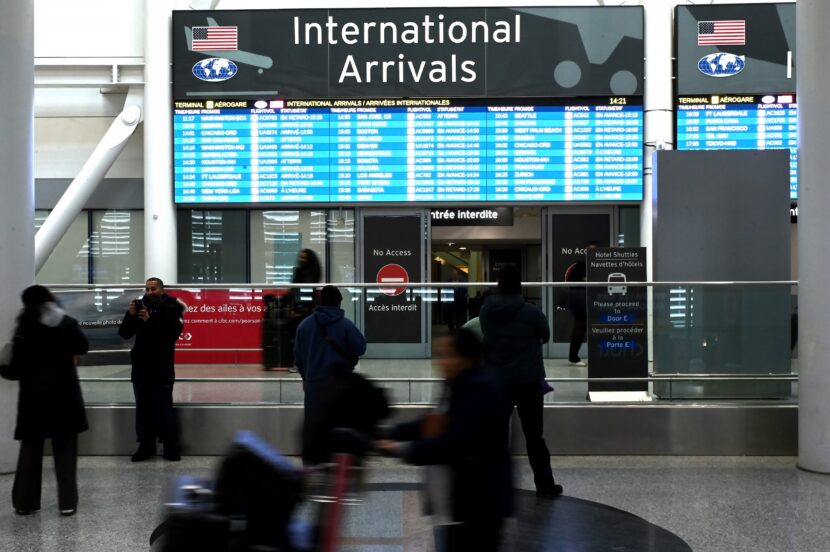
Lead image caption: Passengers arrive at Pearson International Airport in Toronto on Feb.11, 2026 (THE CANADIAN PRESS/Jon Blacker)