





MONTREAL — Air Canada President and CEO Michael Rousseau has apologized in the wake of pushback for his English-only message of condolence following the AC8646 collision at LaGuardia.
Rousseau’s statement comes as Air Canada’s Maintenance teams, who are on site in New York, prepare to move the aircraft to a secured hangar. Once the aircraft is in the hangar, Air Canada teams will begin the process of reuniting people with baggage and personal belongings.
As of today, four of the injured passengers and crew remain in hospital, according to Air Canada’s latest update.
Air Canada and Jazz Aviation are cooperating with the Transportation Safety Board of Canada and the NTSB in the investigation.
“DESPITE MANY LESSONS OVER SEVERAL YEARS, I AM STILL UNABLE TO EXPRESS MYSELF ADEQUATELY IN FRENCH”
Rousseau has been criticized for the four-minute video posted online earlier this week, that only included two French words — “bonjour” and “merci.”
Prime Minister Mark Carney said the decision to release the video message only in English showed a “lack of judgment and lack of compassion.” Rousseau has also been summoned to testify at the House of Commons official languages committee.
In his statement Rousseau said: “As President and CEO of Air Canada, it is my duty to support those affected by this tragedy. I am deeply saddened that my inability to speak French has diverted attention from the profound grief of the families and the great resilience of Air Canada’s employees, who have demonstrated outstanding professionalism despite the events of the past few days.

Air Canada’s President and CEO, Michael Rousseau
“Despite many lessons over several years, unfortunately, I am still unable to express myself adequately in French. I sincerely apologize for this, but I am continuing my efforts to improve.
“I am also very grateful to those who have given the very best of themselves throughout the last few days to take care of our customers and each other while coping with the weight of this tragedy and I have been moved by the messages of support received from so many people who have reached out to express their thoughts for those impacted by Sunday’s tragic accident.”
LEGAL OPTIONS FOR AC8646 PASSENGERS
Aviation law experts say Air Canada passengers injured in the fatal collision at the LaGuardia Airport on Sunday have various legal options.
Gabor Lukacs, a passenger rights advocate, says Air Canada could be on the hook for hundreds of thousands of dollars per passenger.
He says an international agreement that standardizes compensation holds airlines liable for death or bodily injury.
Lukacs says that under the 1999 Montreal Convention injured passengers could each be compensated up to nearly $300,000.
The Air Canada passengers have two years to file lawsuits under the convention.
Kevin Durkin, a U.S. aviation lawyer, says they could also sue the American aviation authority and local port authority.
“NO ONE WAS IN THE BRACE POSITION”
As experts assess the aftermath of a fatal Air Canada Express plane crash at LaGuardia Airport, some have expressed surprise the tragedy wasn’t far worse.
Commercial aircraft are constructed for flight, not for withstanding head-on collisions with fire trucks that can weigh more than 45 tonnes, said Benoit Gauthier, a retired pilot who flew with Air Canada for 37 years. A fully loaded Bombardier CRJ-900 — the jet that collided with the truck late Sunday night — weighs about 38 tonnes.
“Airplanes are basically built to deal with air. And cockpit domes, especially the bottom part, most of it is fibreglass or some sort of composite plastic,” Gauthier said.
“There’s not that much metal in there. If you hit anything solid … it would basically destroy it, which is what happened.”
The fuselage, which is the main body of a plane, can handle glancing blows at lower speeds while the landing gears and subflooring are made with shock absorption in mind for emergency landings. But the aluminum alloy that forms the main structure of commercial jets aims for lightness, with minimal energy-absorbing capacity in the nose of the plane.
“If you built an airplane strong enough to take that kind of impact, it would never get off the ground because it would be too heavy,” said Nigel Waterhouse, president of Montreal-based Can-Am Aerospace.
“Aircraft are not built like cars. They’re not designed for collisions like that.”
Added John Gradek, who teaches aviation management at McGill University: “That the fuselage of the aircraft sustained damage only as far back as the front door of the airplane is a miracle.”
Experts attributed the outcome to both the quick braking of the pilots — who flew for Air Canada Express carrier Jazz Aviation — and the fact the fire truck absorbed some of the kinetic energy that would have rippled through the 36-metre-long airliner.
“The airplane did not take the full brunt of this hit,” said Shawn Pruchnicki, an assistant professor in engineering at Ohio State University’s Center for Aviation Studies and former accident investigator for the Air Line Pilots Association.
“The vehicle actually took a lot of that energy,” he said. “If that Jazz airplane would have hit something that was immovable, like a concrete barrier, oh my God.”
And had it collided at a higher speed, the destructive force may well have reached farther into the cabin, he said. As it was, the shock proved large enough to eject a flight attendant still strapped into her jump seat on the other side of the cockpit, throwing her from the wreckage.
Sturdy seatbelts and seat fittings played a key role in limiting the harm to passengers.
“Their seats stayed where they were supposed to be,” Pruchnicki said, pointing to improved safety standards over the past two decades that require chairs and belts to withstand massive force in an emergency.
“No one’s seatbelt broke, and they didn’t become a projectile, and that is why everyone did so well.”
That doesn’t mean the crash wasn’t a violent, traumatic experience. Passengers reported being thrown forward, with some sustaining head injuries after smashing into the seatback in front of them.
“No one was in the brace position because they didn’t know that they were crashing — the flight attendants never got a chance to say ‘brace,’” Pruchnicki said.
Other elements that could have set off an even bigger catastrophe were avoided. Leaking jet fuel did not catch fire.
“There’s hot engines behind it,” said Waterhouse. “If that had ignited, it would have been a different story.”
Shortly after 11:30 p.m. on Sunday, an air traffic controller cleared Air Canada Express Flight 8646 to land less than two minutes before clearing a fire truck to cross the active runway, resulting in a collision that left two Canadian pilots dead and sent more than 40 people to hospital.
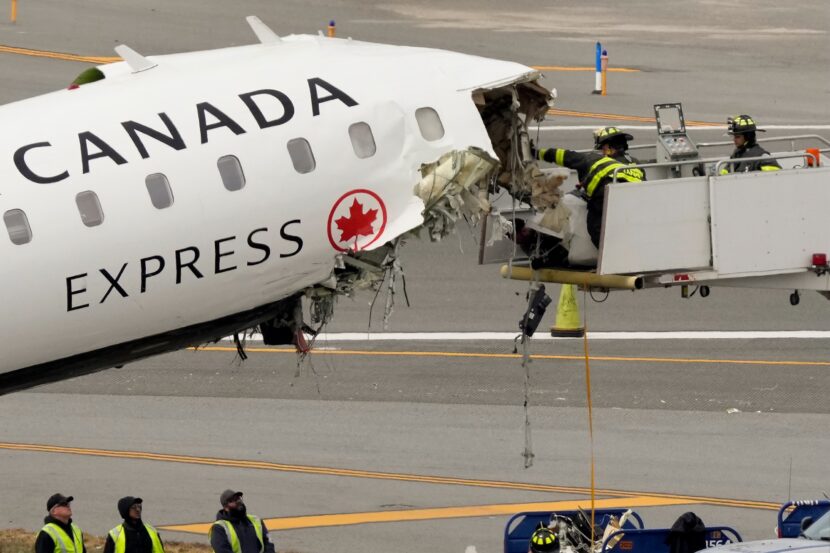
Footage shows the jet speeding along the rain-streaked strip as the truck crosses its path, veering away too late from an impact that unleashed a trail of smoke and debris as the plane skidded more than 100 metres farther, its cockpit obliterated.
The controller recognized the danger moments beforehand, instructing the truck to “stop” — 12 times in 10 seconds — but receiving no reply.
Reflecting on the tragedy, Gauthier said: “In my 42 flying years, I never had anything remotely close to that on landing or takeoff.”
Lead image caption: Airport firefighters remove loose debris from the wreckage of an Air Canada Express jet, March 25, 2026, just off the runway where it had collided with a Port Authority fire truck Sunday night at LaGuardia Airport in New York (AP Photo/Yuki Iwamura)