





TORONTO — IATA Director General Willie Walsh says even a two-week ceasefire in the Iran war is a bit of good news for the airline industry, as the price of oil continues its turbulent ride.
Even as oil prices drop, however, travellers may not see relief right away. Experts note that airlines can take months, sometimes even up to a year, to adjust fares and fees as they wait for energy markets to stabilize.
Oil prices have swung wildly in recent weeks, briefly topping US$119 a barrel at one point, and then plunging Wednesday below $95 after word of the two-week ceasefire in the Middle East that briefly reopened the Strait of Hormuz. But the uncertainty behind those swings remains, especially after Iran closed the key artery for global oil shipments again in response to Israeli strikes in Lebanon.
Speaking to Bloomberg this week in Singapore at the IATA World Data Symposium, Walsh said: “Even two weeks is a positive. We’ll hopefully see some flow of oil return… it’s a positive development.”
Walsh noted that airlines rely on the supply of crude oil, and more importantly, the supply of the refined product, for jet fuel.
The price of jet fuel has gone up significantly more than the price of crude, he noted. “I think if the crude does come down, I’d like to think the jet will come down too, but it will remain elevated for some time.
“It’s still going to be a high price, and as I’ve said before, that will mean higher ticket prices. That’s inevitable. There’s no way airlines can absorb the increase that they’re witnessing.”
In addition to higher airfares and surcharges, airlines are also considering or already making capacity reductions. “A sensible measure,” said Walsh.
In Canada, tour operators including ACV, Sunwing, Vacances WestJet Québec and Transat, and airlines including WestJet, Air Transat and Porter, have all announced surcharges.
“TRYING TO MAKE BETS ON WHAT THEY THINK WILL HAPPEN IN THE FUTURE”
“Volatility is the real story here,” said Shye Gilad, a former airline captain who now teaches at Georgetown University’s business school in the U.S. “Right now, the airlines are trying to make bets on what they think will happen in the future.”
Gilad added: “When prices move quickly in both directions, it’s very hard for airlines to make predictions. That’s why there’s a lag between oil market moves and what passengers see in ticket prices.”
After Delta Air Lines increased its checked baggage fees, Delta Air Lines CEO Ed Bastian told reporters: “At this level of fuel, it’s hard to call anything temporary.”
Bastian said Wednesday as Delta kicked off the earnings season for U.S. airlines that the higher fuel prices are expected to add $2 billion in operating expenses in the second quarter alone.
United Airlines CEO Scott Kirby said in a recent memo to staff that if jet fuel prices stay elevated, it would mean an additional $11 billion in annual costs. That’s more than double what United earned in its most profitable year.
“For perspective,” he said, “in United’s best year ever, we made less than $5 billion.”
According to IATA, the average global jet fuel price rose to $209 per barrel last week, up from roughly $99 at the end of February when the war started.
BNP Paribas estimates that global schedules for April have been cut roughly 5% compared with earlier plans. Most reductions are in the Middle East, the global investment bank said, though smaller cuts were also emerging in Europe, Asia and North America.
“WHAT WE’RE SEEING IS HESITATION”
Some Canadians are looking to lock in their trips sooner as a way to secure prices and availability, rather than waiting and hoping for a deal, said Amra Durakovic, head of communications for Flight Centre Travel Group.
“(Fuel) prices are still adjusting,” she said, but added that it appears rising prices haven’t deterred travel demand so far.
Jason Sarracini, CEO of travel agency OST.travel, said flights that don’t go through the Middle East are still “pretty stable,” with fewer disruptions compared with routes that do, such as flights bound for the Philippines, Thailand or other Southeast Asian countries.
Sarracini said he hasn’t noticed a rush among most of his customers to book trips well in advance. Nor have they rushed to cancel their plans, save for some international travel.
“What we’re really seeing is hesitation,” he said. “It’s creating doubt in the consumer’s mind.”
He said a lot of people are taking a wait-and-see approach. “Worst-case scenario, we stay home and we don’t travel or we visit our own country this year,” he said of travellers’ mindsets.
Higher travel costs are also playing out alongside the ongoing boycott of travel to the U.S., further convincing many Canadians to vacation close to home — or where they feel safe, he said.
“Safety and costs sort of go hand in hand right now, given everything that’s happening in the world,” he said.
Durakovic agreed. She said travellers are focused on value and strategy, such as less-expensive destinations and flexibility on travel timing — with safety in mind. Sun destinations, Europe and domestic travel are top-of-mind for Canadians, she said.
Sarracini said airlines can only increase fares so much before consumer demand falls. He suspects prices are likely to stabilize in the coming weeks as most airlines lock in their fuel contracts.
“The increase in surcharges or increases in fares from the airlines will stabilize, given everything we know today,” he said.
Sarracini added it would give consumers “a really good sense of what’s out there and be able to make a call in the next couple of months.”
With files from The Canadian Press and The Associated Press
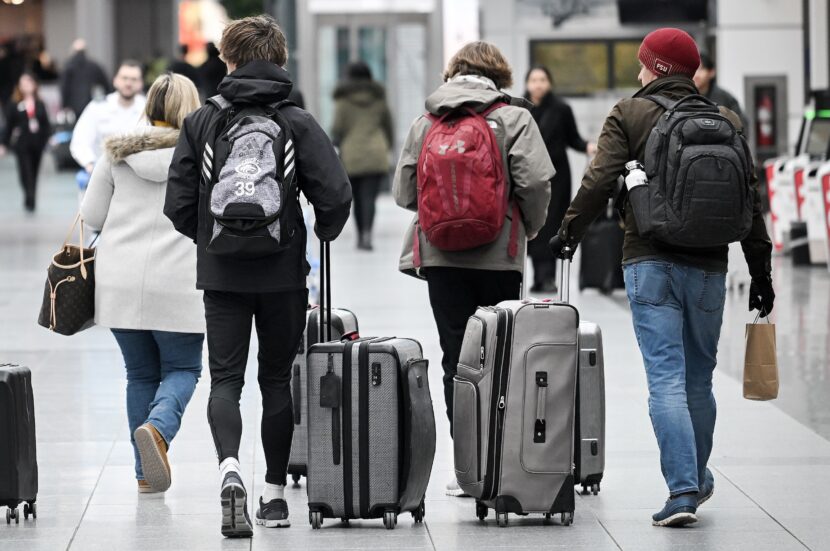
Lead image caption: Travellers wheel and carry their luggage through Trudeau airport in Montreal (THE CANADIAN PRESS/Graham Hughes)
