





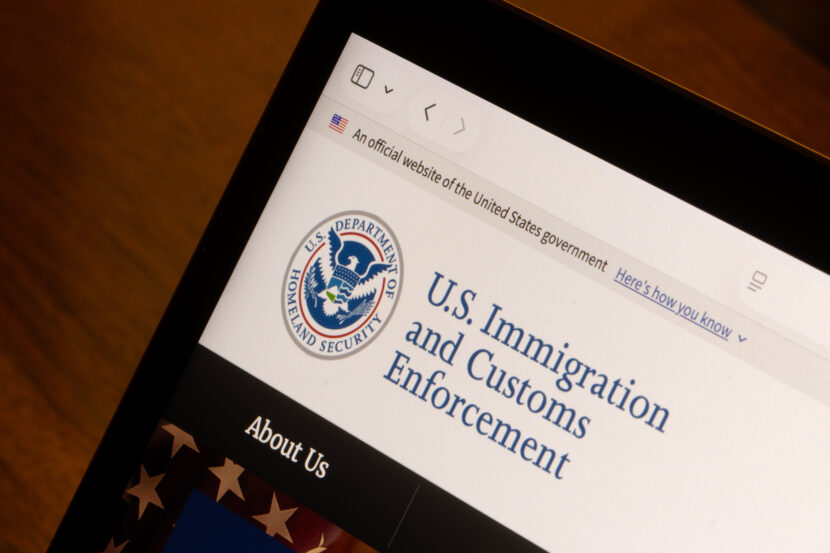
TORONTO — Canadian travellers heading to the U.S. or transiting through American airports may notice a heightened law enforcement presence, as Immigration and Customs Enforcement (ICE) officers have been deployed alongside Transportation Security Administration (TSA) staff at select airports.
As reported by Global News, the move is tied to a U.S. government shutdown strategy that saw ICE officers assisting with duties such as monitoring exit lanes and checking identification at airport security checkpoints.
While federal officers are typically present at international airports, their visibility at TSA screening areas is unusual. ICE agents were recently spotted at several major hubs, including Hartsfield–Jackson Atlanta International Airport, Louis Armstrong New Orleans International Airport, and George Bush Intercontinental Airport and William P. Hobby Airport in Houston.
For Canadian travellers, the rules governing entry into the U.S. have not changed – but the increased visibility of enforcement may come as a surprise.
“For Canadians, the rules haven’t really changed. Border officials still have very broad powers. I think what’s really a catching Canadians off guard a little bit isn’t the new rules, but the visibility of enforcement,” Mario Bellissimo, founder and policy analyst at Bellissimo Law Group PC, told Global News.
Those “broad powers” remain an important consideration for travellers, particularly if they are referred for additional screening.
“The first officer you’re going to meet will collect initial information and conduct an assessment to determine, ‘should we dig deeper here?’ And if that is the case, then it’s moved to secondary. That’s really where the inquiries become extensive and can lead to delays and ultimately, refusals or enforcement action at the border.”
Travellers should also be aware that U.S. border officials may request access to personal devices.
“Your smartphone now houses more information, likely than if someone ransacked your home or went through all the documents in your home,” Bellissimo said.
He added that while some may consider travelling with a secondary or “burner” phone, that approach could raise further concerns with authorities.
If a traveller is detained, legal experts stress that U.S. laws apply.
“Canada can have consular support, can assist families, but ultimately Canada can’t overturn a decision of a foreign jurisdiction and that includes the United States,” Bellissimo said.
Guidance from the American Civil Liberties Union notes that individuals have the right to hire a lawyer, though one will not be provided by the government. Travellers may also contact family members and receive visits from legal counsel while in detention.
To minimize complications, preparation and transparency are key.
“I go back to best practices. Be truthful, be consistent, be clear. If your intention is consistent on why you’re entering the United States and the documentation support that, you’re going to be just fine,” Bellissimo said.
Travellers are advised to carry supporting documentation, including return tickets and proof of the purpose and duration of their visit.
Canadian citizens and permanent residents requiring assistance can contact the Canadian embassy in Washington, D.C. or consulates across the U.S., as well as Canadian Citizen Services at ccs.scc@international.gc.ca or 1-844-880-6519.
