





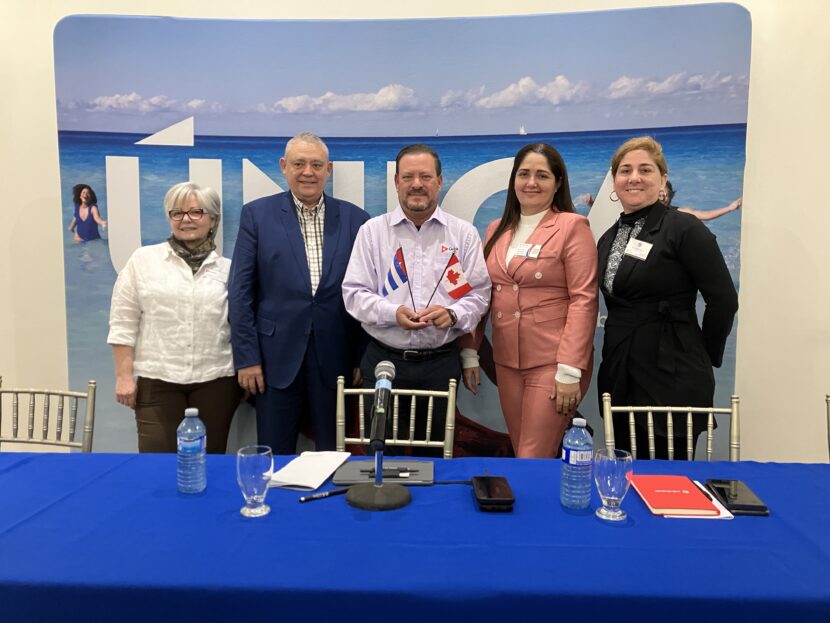
MISSISSAUGA — Amid recent comments from U.S. President Trump threatening to halt Venezuelan oil shipments to Cuba, the country’s Ministry of Tourism is pushing back against misconceptions about possible fuel shortages and widespread power outages.
Speaking at a press conference yesterday, Jan. 14, in Mississauga, Lessner Gomez, Marketing Director of the Ministry of Tourism of Cuba (MINTUR), urged Canadian travellers to not be swayed by recent media reports.
“I want to reaffirm that Cuba continues to be a safe destination with very hospitable people who stand in solidarity. It’s business as usual,” said Gomez, adding the country receives an average 120 flights a week from Canada and hopes to welcome one million Canadian visitors this year.
Gomez’s assurances come more than a week after Venezuelan president Nicolás Maduro was captured by U.S. forces in Caracas, and three days after Trump wrote on his Truth Social platform on Sunday: “THERE WILL BE NO MORE OIL OR MONEY GOING TO CUBA — ZERO! I strongly suggest they make a deal, BEFORE IT IS TOO LATE.”
Trump did not provide any details about the deal. When asked by Travelweek, Gomez dismissed suggestions of direct talks between U.S. and Cuban leadership. “Yesterday, Trump said that he spoke with the Cuban president. But the press asked the president about it and he said this isn’t true – he never spoke with Trump.”
Myth One: Cuba Relies Solely on Venezuelan Oil
One major myth surrounding Cuba’s current situation is the belief that the country depends entirely on Venezuela for fuel. This is not the case, said Gomez.
“Cuba is a sovereign country and we have many different contracts with many different countries. From all these different contracts, we get all the fuel for everything we need to run the country,” he said, noting that just three days prior, Cuba received a new shipment from Mexico. “And who knows, with our good relationship with Canada, we can probably get fuel from Canada, too.”
This diversification in fuel supply will carry the country through to at least the summer season, he added. “Our hotels have enough fuel for the short-, medium- and long-term.”
Gomez also clarified that aviation fuel has never been sourced from Venezuela due to the nature of its oil.
“Before the Venezuela situation, the fuel was being used for flights did not come from Venezuela. The characteristic of Venezuelan oil is heavy, which is why it was never used for airplanes,” he said.
Earlier this week at a similar press conference in Montreal, Canadian travel partners were provided with a signed letter from the Cuban Aeronautical Institute confirming that airports and hotel operations have the fuel and supplies needed to sustain the winter season.
Myth Two: Blackouts are Disrupting Tourism
Despite recent media reports of power outages across the country, Gomez stressed that a lack of fuel is not to blame and that resort areas remain unaffected.
“The main issue with the blackouts isn’t due to fuel – the grid is aging and authorities did not receive a proper maintenance schedule,” he said.
Notably, all major tourist zones in Cuba operate independently of the national electrical grid.
“Our hotels in all tourist destinations operate on their own grid separate from the national grid. Plus, hotels have their own generators that can be used if needed to run operations,” added Gomez.
To address long-term concerns, Gomez said the country has been developing renewable energy solutions for the past few years. For example, at the Melia Trinidad Peninsula, 80% of the resort operates on solar energy.
“For all new hotels and investments, the number one consideration is the inclusion of renewable energy,” said Gomez.
Addressing Mosquito-borne Illnesses
Cuba is currently dealing with outbreaks of mosquito-borne illnesses including dengue, chikungunya and the new Oropouche virus. As reported by CTV News, officials have reported more than 38,000 suspected cases of the diseases.
Noting Cuba’s tropical geography and its similarities with many Caribbean destinations, Gomez said these concerns are not unique to Cuba and apply to multiple destinations across the region.
“Mosquitos are common for all tropical climates – they’re not exclusive to Cuba. There were upwards of nine other countries included in Canada’s travel advisory earlier this winter for mosquito-borne illnesses,” he said.
According to Gomez, Cuba will soon implement a plan for pest control and spraying in all the resort areas.
“The latest data from the Ministry of Health shows a downward trend in the number of cases, so this is good news,” he said.
Tour Operators Remain Confident
While media coverage has amplified a short-term slowdown typical for early January, Gomez said tour operators are not overly concerned.
“Sales have slowed a bit, not only in Cuba but elsewhere in the Caribbean. But Cuba is very resilient,” he said.
Nieves Ricardo of the Cuba Tourist Board echoed that sentiment, pointing to strong relationships with the Canadian trade.
“Yes, there is concern in the market due to media reports, but I think we have been able to educate travel agents on how to sell Cuba,” she said. “Travel agents and Canadians are Cuba-savvy – they know what Cuba is all about, they love it and they keep coming back.”
What’s New & Upcoming Events
Cuba continues to invest in airlift, tourism infrastructure and market-specific initiatives aimed at supporting demand from Canada. New air service includes WestJet’s recently launched Toronto–Havana route, which kicked off in December.
The destination’s events calendar remains a key draw for Canadians, with Havana’s annua Cigar Festival in February and FitCuba, the country’s most important tourism event, in early May. This year’s event will showcase Canada as a special guest of honour. And looking ahead, 2026 will also mark the 80th anniversary of diplomatic relations between Cuba and Canada.
On the accommodation front, Gaviota Hotels is expanding its ‘Playa Luxury’ concept across Cayo Guillermo, Varadero and Holguin, while also introducing ‘Playa Kids,’ a new family-focused concept. The company has also rolled out its ‘All In’ program, allowing guests staying in Cayo Santa Maria, Cayo Ensenachos and Cayo Las Brujas to access dining, entertainment and attractions across the island at no additional cost. Additional enhancements include the opening of the Splash Santa Maria waterpark in Cayo Santa Maria.
Cuba is also strengthening its connection with the Canadian market through weekly ‘Canadian Day’ celebrations held every Thursday in tourist plazas across resort areas. At the same time, the destination is working to expand long-stay offerings, targeting Canadians seeking extended winter stays and alternatives to travel in the United States.
As Gomez concluded: “My main message today is a huge thank you to all our travel partners and travel advisors in Canada. The Canadian people have been supportive of Cuba for a long time. Canadians love Cuba and Cubans love Canadians.”
Lead image caption, from l-r: Nieves Ricardo, Cuba Tourist Board; Carlos Latuff, President, Gaviota Hotels; Lessner Gomez, Marketing Director, Ministry of Tourism of Cuba; Gipsy Hernández Perdoma, President, Cubanacan Hotels; Gihana Galindo Enríquez, Director, Cuba Tourism Office-Toronto
